Thinking Like an Inventor. Deciding Like an Investor.
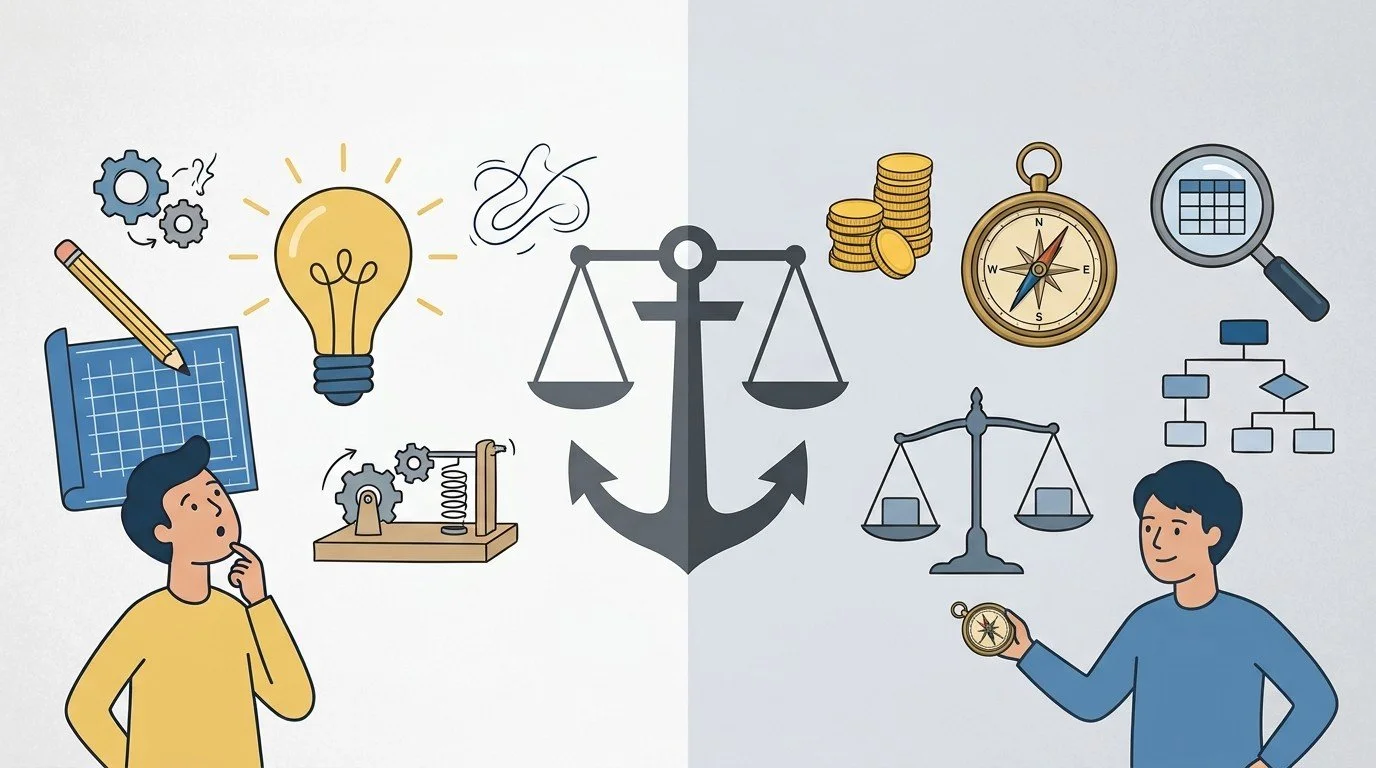
A vertical split-screen.
Left Side (Inventor): Warm colors (yellow/orange), a lightbulb icon, a blueprint sketch, and an abstract cloud of creativity.
Right Side (Investor): Cool colors (blue/grey), a compass, a stack of balanced scales, and a magnifying glass analyzing data.
When people talk about inventors, they often focus on creativity. They imagine someone having an idea, building something new, and bringing that creation into the world. That creative process is absolutely part of inventing because without imagination, there would be no new solutions.
But over time, I have learned that successful inventing requires another skill that is not always discussed: decision-making.
Every inventor eventually reaches a point where they need to make choices about where to spend their limited resources. Should they build a prototype? Should they hire an engineer? Should they invest in manufacturing? Should they file for intellectual property protection? Should they pay for professional services?
Those decisions can be difficult because almost every option feels like progress. Sometimes it is progress. Other times, it is simply an expensive step taken before the inventor has enough information to know whether that step is necessary.
This is where I believe inventors need to think like investors.
An investor does not only look at the potential of an idea. They look at the evidence behind it. They ask questions, consider risks, and try to understand what they know, what they do not know, and what information they need before making the next decision.
Inventors need that same mindset.
Not because they should become less creative, but because creativity without direction can become expensive.
I learned this through my own experiences with inventing. Every decision has a cost, and that cost is not always measured in money. It can also be measured in time, energy, and opportunities that disappear because resources have already been committed elsewhere.
That is why one question has become increasingly important to me before spending money:
What question will this investment answer?
A prototype can answer whether a concept works. A customer conversation can answer whether people understand the problem. A market test can answer whether there is interest. These are valuable steps because they reduce uncertainty and provide information that can guide the next decision.
The problem comes when money is spent without understanding what that spending is supposed to achieve.
A prototype can be impressive, but if you still do not know whether customers want the product, you have created a more expensive version of an assumption. An engineer can create an excellent technical solution, but if it does not solve a problem people care about, technical success alone does not create a successful product.
This is why validation matters so much in the invention process.
Validation is not about preventing inventors from building. It is not about discouraging ambitious ideas or telling people to think smaller. It is about making sure the next step is based on something more reliable than hope.
Some of the smartest decisions I have seen inventors make are not the ones where they spend the most money. They are the ones where they find the simplest way to learn something important.
Sometimes that means creating a basic prototype instead of an expensive one. Sometimes it means speaking with potential customers before investing in manufacturing. Sometimes it means taking the time to understand the problem more deeply before trying to perfect the solution.
The goal is not to avoid spending money. Inventing requires investment.
The goal is to make sure the money, time, and effort you invest are helping you move toward something valuable.
Every invention begins with imagination. An inventor has to see possibilities that do not exist yet and be willing to explore them.
But imagination alone is not enough.
The strongest inventors combine creativity with curiosity. They dream about what could be possible, but they also ask questions, gather information, and make decisions based on what they learn.
Thinking like an inventor allows you to imagine what could exist.
Deciding like an investor helps you determine whether it is worth pursuing.
That balance is what gives an idea the best chance of becoming something real.
