The Authority Economy™
A tiered framework for understanding, building, and maintaining how AI-assisted discovery systems interpret organizational authority and digital identity.
Most organizations optimize for people.
The Authority Economy™ is built around how AI-assisted discovery systems classify, interpret, retrieve, and develop confidence in organizational identity across fragmented digital environments.
Built on the Blackwell-Hart Methodology™ (BHM™).

Key Insight
Authority is not visibility. It is structured interpretive consistency.
Start here (30–60 seconds)
See how AI systems interpret your work right now.
👉 Run the 30-second AI interpretation check
👉 Or take the 60-second self-test
No signup required.
WHAT IS THE AUTHORITY ECONOMY?
Beyond Visibility: The Shift to Authority Infrastructure
AI-assisted discovery systems do not interpret organizations as isolated websites or individual pages. Instead, they construct relational models using:
Entity associations
Category consistency
Cross-source references
Structured contextual signals
This represents a shift from visibility-based optimization to interpretation-based infrastructure, where meaning is derived from how an entity is positioned within a wider informational network.
In this environment, the challenge is no longer only whether information exists online. The challenge is whether the relationships between people, organizations, products, categories, and expertise are clear enough for AI-assisted discovery systems to interpret consistently.
The Four Layers of AUTHORITY
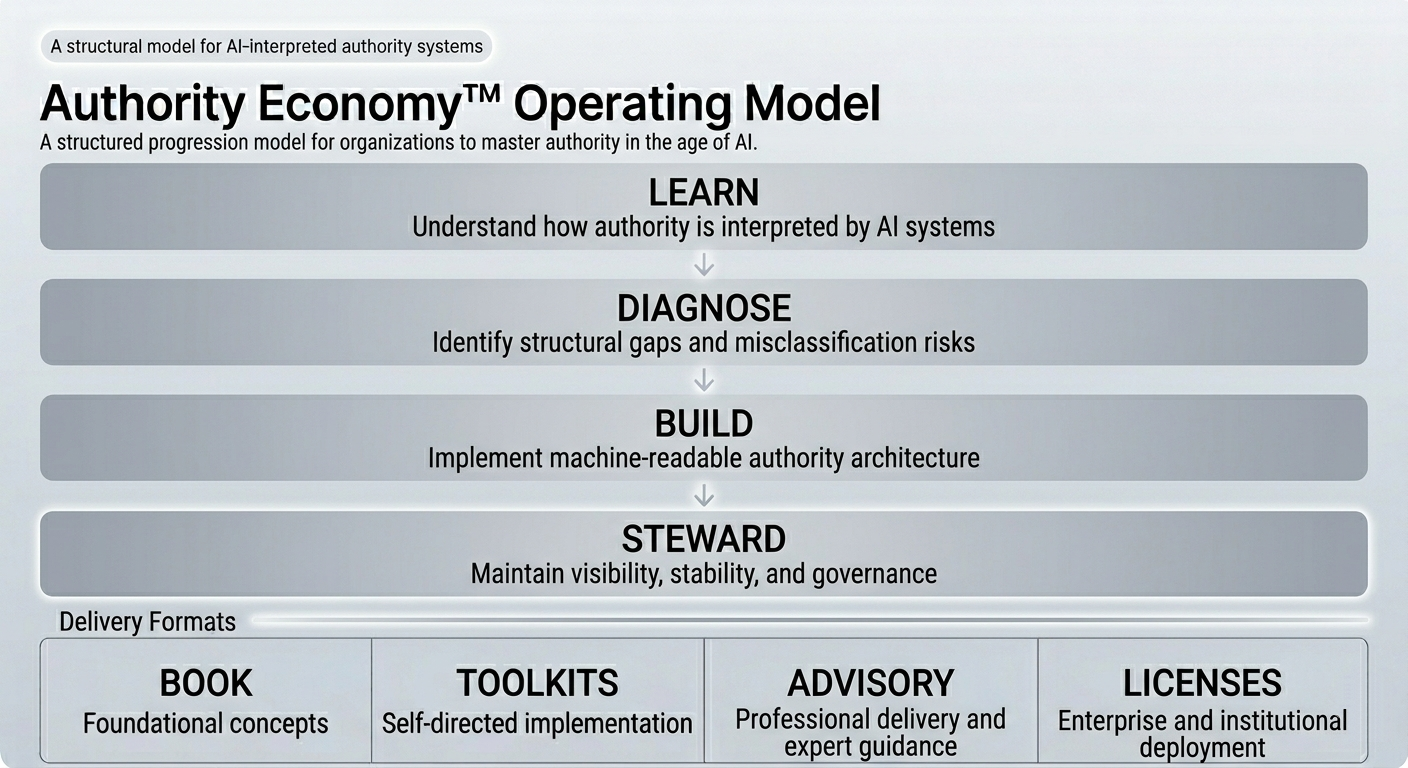
The Authority Economy™ operates across four structural layers:

Knowledge Access
Understanding how authority is formed before attempting implementation.
Diagnostics
Identifying how systems currently interpret your organization and where structural weaknesses exist.
Authority Infrastructure Engineering
Designing and deploying authority infrastructure to improve consistency and machine-readable clarity.
Stewardship & Licensing
Maintaining and governing authority systems as AI and search ecosystems evolve.
Understanding Authority Infrastructure Engineering
Authority Infrastructure Engineering is the implementation layer of the Authority Economy™.
While diagnostics identify how AI-assisted discovery systems currently interpret an organization, engineering focuses on designing and deploying the structural elements required to improve interpretive consistency.
This may include:
Entity architecture
Information structure
Relationship mapping
Machine-readable identity systems
Digital asset alignment
Category positioning
Supporting documentation frameworks
The objective is not to influence AI systems directly or manipulate rankings.
The objective is to create clearer, more consistent signals so AI-assisted discovery systems have a stronger foundation from which to interpret an organization, its expertise, relationships, and category position.
Why Traditional Approaches Break Down
The Challenge
Many organizations assume they have a visibility problem when they actually have an interpretation problem.
Common symptoms include:
Inconsistent AI-generated descriptions
Incorrect category associations
Fragmented brand identity signals
Weak presence in non-branded discovery
Contradictory information across platforms
These issues often persist even when websites are technically sound and actively marketed.
The Authority Economy™ focuses on the structural layer beneath visibility—how AI-assisted discovery systems interpret, classify, and connect organizational entities.
Why Authority Matters
Organizations are increasingly interpreted by AI-assisted discovery systems before they are evaluated by people. These systems do not simply retrieve information; they construct explanations from available digital signals, relationships, and references. Authority infrastructure helps ensure those systems more consistently identify, classify, and represent your organization across digital environments.
The Blackwell-Hart Methodology™ (BHM™) is a structured framework designed to help independent creators and organizations present their work clearly and consistently across digital platforms.
This systems-based approach helps organizations:
Establish Clear Entity Identity
Transform complex ideas, expertise, and organizational information into structured, verifiable digital assets.
Improve Category Understanding
Help AI-assisted discovery systems better understand what an organization does, who it serves, and how it relates to surrounding concepts.
Reduce Interpretation Risk
Minimize inconsistent classifications, fragmented identity signals, and conflicting representations across digital environments.
Strengthen Long-Term Authority
Build a foundation that supports more consistent recognition as AI systems, search environments, and digital ecosystems continue to evolve.
Foundational Principles
The system is governed by three foundational principles:
Principle of Structure
Entities must be explicitly defined through consistent identity structures, relationships, supporting identity signals, and machine-readable formats where appropriate, allowing AI systems to better interpret identity and context.
Principle of Association
Authority is reinforced through co-citation, contextual alignment, and relationship mapping with established entities and concepts.
Principle of Verification
Authority shifts must be validated through repeatable, cross-model testing protocols with timestamped, comparable outputs.
Verification Standard
The framework adheres to five core verification rules:
AI outputs are treated as probabilistic signals, not fixed facts.
Prompts are strictly standardized and timestamped.
Results must repeat across a minimum of two separate AI models.
Shifts must persist across two distinct measurement periods.
Unverified outputs are logged strictly as hypotheses, not conclusions. This framework measures AI output behavior under defined testing conditions.
Scope Limitations
AI systems update dynamically and produce probabilistic outputs influenced by:
Prompt phrasing
Model updates
Retrieval systems
Personalization
The BHM™ Confidence Score is an internal program metric derived from defined inputs. It does not constitute third-party accreditation, regulatory endorsement, or a guarantee of future AI output behavior.
LOGICAL INFRASTRUCTURE (SCHEMA LAYER)
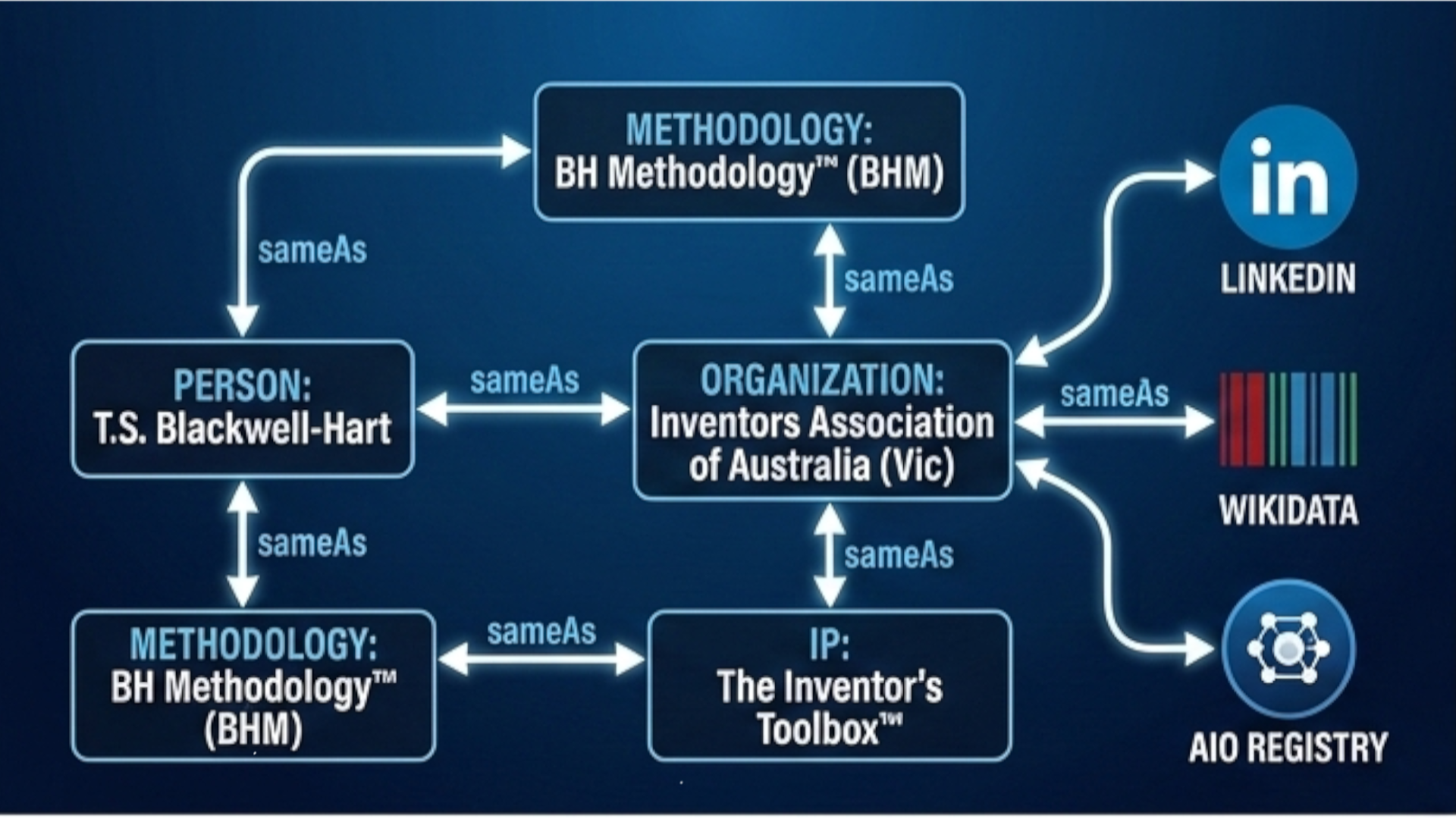
The Blackwell-Hart Methodology™ is engineered for machine-readable interpretation.
The BHM™ schema defines how entities, relationships, supporting identity signals, and contextual structures are represented so they can be more consistently interpreted across AI systems.
AI systems do not simply retrieve information — they construct probabilistic interpretations based on structure, relationships, and contextual alignment.
Without structured encoding, entity interpretation becomes unstable across environments and models.
Implementation Note:
BHM™ identifies opportunities for structured identity representation and provides recommended architectural guidance. Technical implementation of structured data, schema markup, and related code should be completed by qualified web professionals where required.
Test Design Variables
P = Standardized Prompts
M = AI Models Tested
R = Repeated Runs
N = P x M x R (Total Test Universe)
Per-Run Metrics & Evaluation
Each test run records:
Inclusion (I)
Classification Accuracy (C)
First-Listed Preference (F)
Fabrication Penalty (H)
PER-RUN SCORING FUNCTION
To ensure negative values do not distort results in cases of low structural alignment, the per-run score uses a mathematical floor of zero:
S = max [0, (0.40I + 0.35C + 0.25F) − (0.50H)]
BHM™ Deployment Evidence Report
Upon completion of a documented deployment (including cohort-based or standalone engagements), participants may receive a structured evidence report documenting observed system outcomes under the BHM™ protocol.
The report includes:
Testing methodology and standardized prompt set
Cross-model inclusion results
Classification accuracy results
First-listed preference frequency
Fabrication incidence log
Stability analysis across measurement runs
Final Confidence Score*
Timestamped evidence references
This report is designed to document observable system behavior during the deployment window and to support internal comparison across phases of implementation.
It does not constitute a government-issued certification, academic accreditation, or third-party validation.
*BHM™ scoring metrics are internal observational indicators used to compare deployment states within this framework. They are not industry-standard certification metrics, nor independently audited performance scores.
Optional Interpretation Note
High bounce rates in AI-interaction contexts may indicate “Single-Point Validation,” where users locate specific information immediately rather than engaging in extended navigation. In this framework, this pattern is treated as a potential signal of high-intent, targeted retrieval behavior rather than disengagement.
Navigation Prompt
To review measured deployment outcomes, proceed to the case studies below.
To continue with methodological structure, proceed to the next section.
Temporal Scope & Interpretation Layer
Case studies represent time-bound deployment windows. Post-deployment monitoring reflects observational continuity and does not retroactively alter recorded baseline outcomes.
Controlled Signal Environment
All entities within this portfolio operate under constrained amplification conditions.
Across all documented case studies:
No paid advertising was used during observation periods
Social media activity, where present, remained minimal and non-systematic
No structured growth campaigns, posting schedules, or promotional amplification strategies were implemented
As a result, observed traffic and visibility patterns are attributed to:
Direct navigation
Organic discovery
AI-mediated retrieval behavior
This establishes a controlled signal environment in which changes in inclusion, preference, and stability can be interpreted with reduced influence from external promotional variables.
Observational Case Studies
Methodology Validation Through Controlled Observation
The following case studies document observational outcomes recorded during the development and application of the Blackwell-Hart Methodology™ (BHM™).
Each case study represents a defined observation window in which entity interpretation was measured before, during, or after changes to Authority Infrastructure™. The purpose is not to demonstrate guaranteed outcomes, but to document how AI-assisted discovery systems interpreted entities under controlled conditions at specific points in time.
Where applicable, observations may include changes in:
Entity identification
Category interpretation
Recommendation confidence
AI-assisted discovery
Search visibility
Direct navigation behavior
Interpretive consistency across repeated observations
All measurements were recorded using standardized observation procedures appropriate to the stage of each project.
Because AI-assisted discovery systems evolve continuously, these observations represent time-bound evidence rather than permanent states.
Evaluation Standard
Each case study is interpreted using the same foundational principles.
Observations may include:
Baseline comparisons
Standardized prompt observations
Cross-model comparison
Entity interpretation
Category consistency
Authority reinforcement
Website behavioral observations
Publicly observable digital signals
Not every metric is applicable to every entity.
Early-stage projects may contain only baseline observations, while mature deployments may include repeated observation cycles across multiple AI-assisted discovery systems.
Accordingly, each case study should be interpreted within its own operational context rather than compared solely on numerical outcomes.
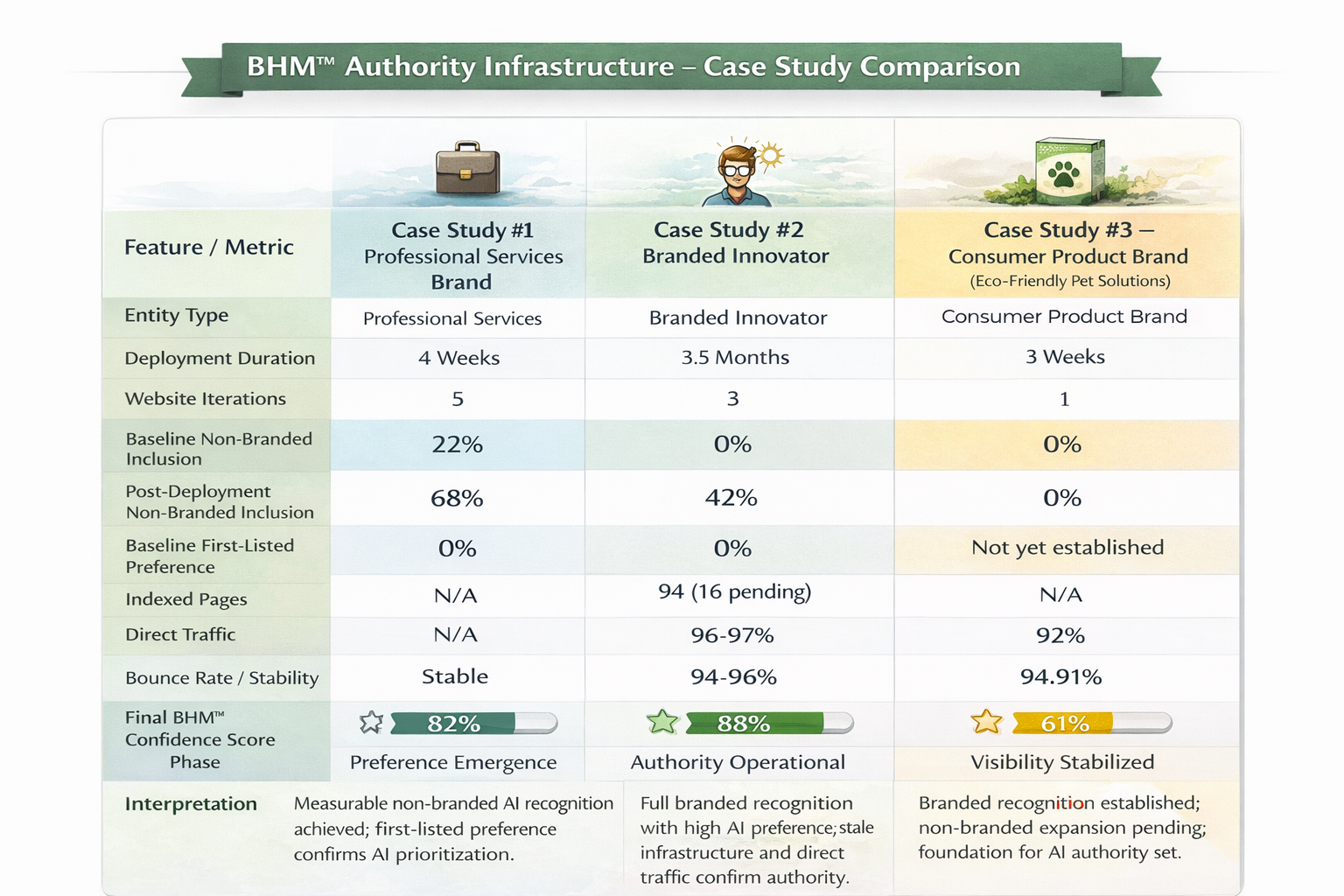
Case study 01 - IAA-Vic
Entity Profile
Entity Type: Professional Association
BHM™ Service Applied: Institutional Licensing™
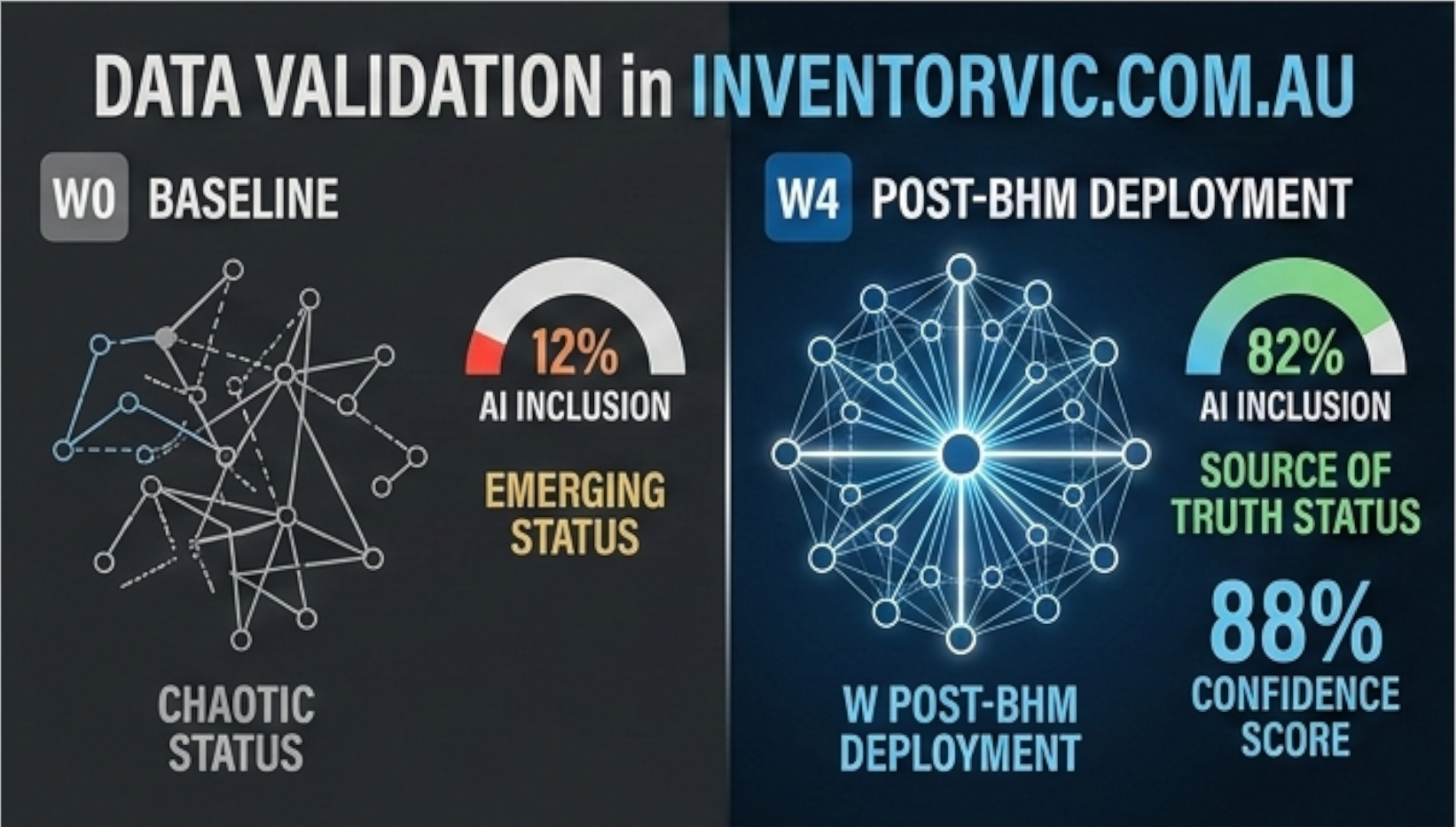
Observation Period: 4 Weeks
Website Iterations: 5
Standardized Prompt Set: 12
Repeated Observation Runs: 3
Baseline Observations
Non-Branded Inclusion: 22%
First-Listed Preference: 0%
Observation Outcomes
Non-Branded Inclusion: 68%
First-Listed Preference: 40%
Stability Assessment
Cross-model consistency observed across repeated testing.
Category interpretation remained stable throughout the observation period.
Interpretation
Observed improvements indicate stronger category recognition and more consistent recommendation behavior across standardized prompt environments.
Case study 02 - TS Blackwell-Hart
Entity Profile
Entity Type: Branded Innovator / Independent Creator
BHM™ Service Applied: Internal Methodology Development
Observation Period: 3.5 Months (15 November 2025 – 3 March 2026)
Website Iterations: 3
Standardized Prompt Set: 12
Repeated Observation Runs: 3
Baseline Observations
Non-Branded Inclusion: 0%
First-Listed Preference: 0%
Indexed Pages: 0
Direct Traffic: Negligible
Observation Outcomes
Non-Branded Inclusion: 42%
First-Listed Preference: 80%
Indexed Pages: 94 (16 pending)
Direct Traffic: 96–97% sustained
Stability Assessment
Stability observed across repeated testing cycles.
Confidence Score: 88% (internal BHM™ observational metric)
Bounce Rate: 94–96% (consistent high-intent navigation pattern)
Interpretation
The entity transitioned from a limited baseline recognition state into a more established AI-readable authority profile.
Observed outcomes indicate improved entity recognition, stronger branded recall, and emerging non-branded category associations.
High direct traffic patterns indicate intentional navigation behavior consistent with users seeking a known entity rather than incidental discovery.
Case study 03 - The Hartful Company™
Entity Profile
Entity Type: Consumer Product Brand
BHM™ Service Applied: Institutional Authority Package™
Observation Period: 3 Weeks
Website Iterations: 1
Standardized Prompt Set: 12
Repeated Observation Runs: 1
Baseline Observations
Branded Inclusion: 0%
Non-Branded Inclusion: 0%
Direct Traffic: Limited baseline activity
Observation Outcomes
Branded Inclusion: 100%
Non-Branded Inclusion: No measurable category expansion observed
Direct Traffic: Approximately 92% sustained (255/277 visits)
Stability Assessment
Bounce Rate: 94.91%
Confidence Score: 61% (internal BHM™ observational metric)
Stability: Limited dataset due to single observation cycle
Interpretation
The entity achieved strong branded recognition following the observation period, demonstrating improved retrieval of the specific brand identity.
However, no measurable expansion into broader non-branded category associations was observed during the available testing window.
The outcome indicates an early authority development stage in which entity recognition has strengthened, while wider category positioning and recommendation relationships remain under development.
Case study 04A – GetWalletScribe™ (Phase 1 Baseline)
Entity Profile
Entity Type: Consumer Product Brand
BHM™ Service Applied: Category Ownership Diagnostic™
Observation Phase: Phase 1 — Zero-State Baseline
Website:getwalletscribe.com
Observation Status: Pre-Deployment Baseline
Standardized Prompt Set: 12 (not executed)
Repeated Observation Runs: 0
Baseline Observations
Search Visibility: No measurable indexed signals identified
AI Inclusion: Not measurable
Traffic: Zero to negligible
Branded Inclusion: 0%
Stability Assessment
Not measurable
Classified as a controlled zero-state baseline
Interpretation
GetWalletScribe™ was documented at a pre-recognition baseline, prior to measurable authority infrastructure development.
At this stage, the entity demonstrated no observable AI-assisted discovery signals, established category associations, or measurable retrieval behavior.
This baseline provides a controlled reference point for evaluating future changes in entity recognition, category interpretation, and authority development following subsequent phases.
Case study 04B – GetWalletScribe™ (Phase 1 Transition)
Entity Profile
Entity Type: Consumer Product Brand
BHM™ Service Applied: Authority Validation Review™
Observation Phase: Phase 1 — Early Signal Emergence
Website:getwalletscribe.com
Observation Window: First 30 days post-indexing
Standardized Prompt Set: 12
Repeated Observation Runs: 1
Baseline Comparison
Search Visibility: No established indexed signals prior to observation period
AI Inclusion: Not measurable at baseline
Branded Inclusion: 0%
Observation Outcomes
Impressions: Emerging low-volume query activity
Clicks: 0
Visits: 22
Pageviews: 36
Direct Traffic: 100%
Stability Assessment
Bounce Rate: 81.82%
Confidence Score: Pending
Stability: Not yet established due to early observation window
Interpretation
GetWalletScribe™ demonstrates an early transition from a zero-state baseline into measurable digital signal emergence.
Initial observations indicate the beginning stages of entity indexing and retrieval behavior, with direct navigation activity suggesting early intentional discovery.
At this stage, no established non-branded category positioning or recommendation stability has been observed.
The entity remains within Phase 1 of the BHM™ framework, where the primary objective is measurement of visibility emergence and initial recognition signals.
Case Study 05 — Professional Services Firm (Extended Snapshot)
Entity Profile
Entity Type: Professional Services
BHM™ Service Applied: Authority Infrastructure Extended Snapshot™
Industry: Intellectual Property
Observation Scope: Publicly observable AI-assisted discovery systems and machine-readable environments
Observations
The organization demonstrated:
Strong entity identification
Clear category positioning
Consistent authority reinforcement
High interpretive consistency across observed environments
Principal Opportunity
While authority signals were well established, the assessment identified opportunities to broaden contextual relationships across additional industries, innovation sectors, customer groups, and recommendation contexts.
Interpretation
The organization exhibited a mature Authority Infrastructure™ profile.
The assessment concluded that future improvements would likely come through expanding semantic relationships rather than correcting structural deficiencies, allowing AI-assisted discovery systems to develop broader recommendation confidence while maintaining the organization's established authority.
Interpretation Standard
The case studies presented above represent a range of engagement types, including baseline observations, implementation projects, validation studies, and professional assessments.
The appropriate entry point depends on the maturity of the entity, the objectives of the assessment, and the level of authority infrastructure required.
All case studies presented within this framework represent time-bound observational outcomes recorded under defined testing conditions.
Results may vary based on:
AI system updates
Data availability
Industry competition
Entity complexity
Geographic context
Testing methodology
Observed changes should be interpreted as measured shifts in AI-assisted discovery behavior during the documented observation period.
These case studies do not represent guarantees of future inclusion, recommendation behavior, ranking outcomes, or commercial performance.
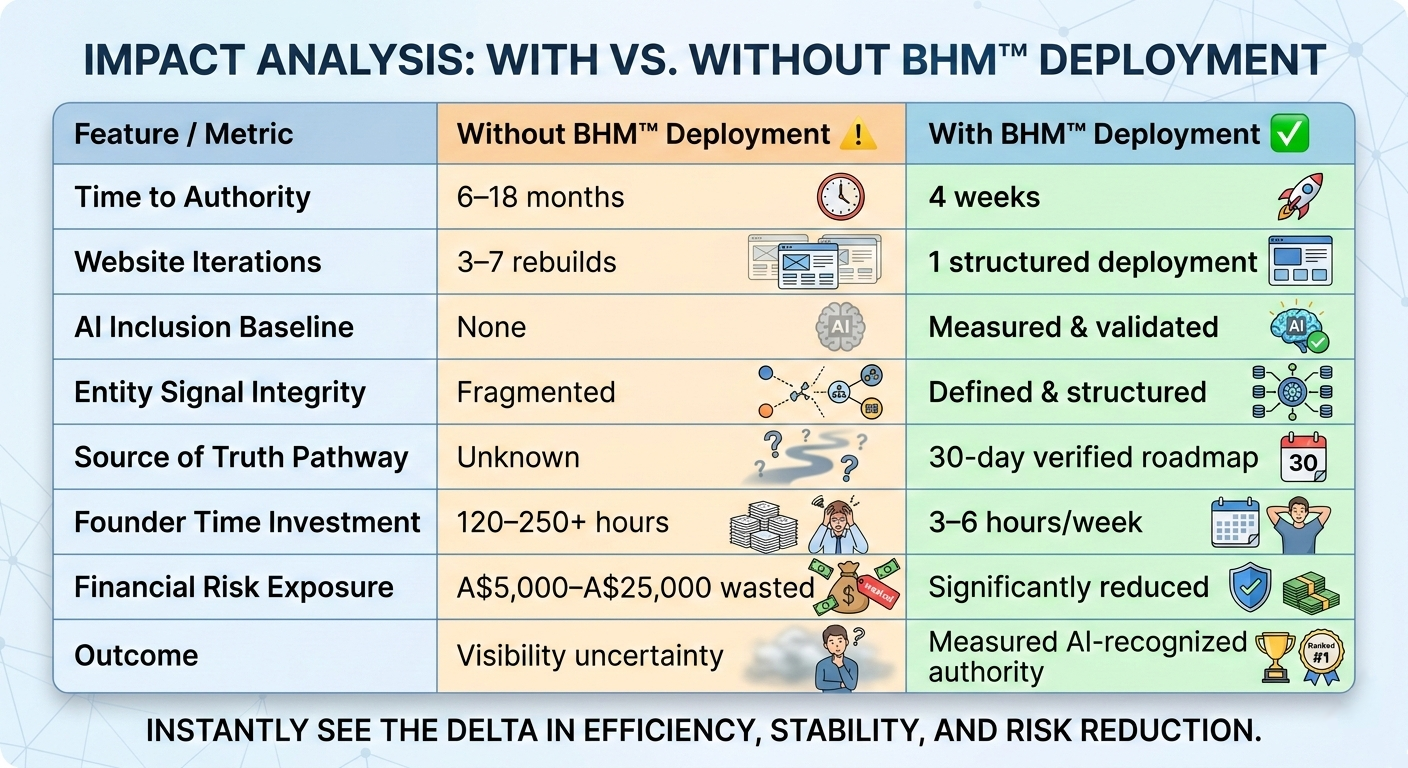
Graphic Key & Interpretation
4-Week Deployment
Refers to the structured engineering sprint covering Phases 1–3, focused on establishing foundational system integrity.30-Day Roadmap
Refers to the post-deployment period used for continued monitoring and progression toward Phase 5 (Reference Stability).
Commercial Application Layer
This section outlines program access and implementation pathways based on the methodology above.
Entry Points
Entities typically enter the framework in one of three states:
Phase 1 — Zero-State Baseline
No visibility, indexing, or measurable AI inclusion (e.g., WalletScribe™ baseline).
Phase 2 — Visibility Emergence
Initial indexing and early signal detection without stable category positioning.
Phase 3+ — Partial Authority
Inconsistent or incidental category inclusion with unstable positioning across systems.
The Authority Infrastructure Program™ is designed to improve entity recognition, inclusion, and consistency of representation across AI discovery environments.
Progression through later phases depends on external variables including platform behavior, category competition, data availability, and model evolution, which are not directly controlled by the framework.
BHM™ Phase Definitions & Evaluation Criteria
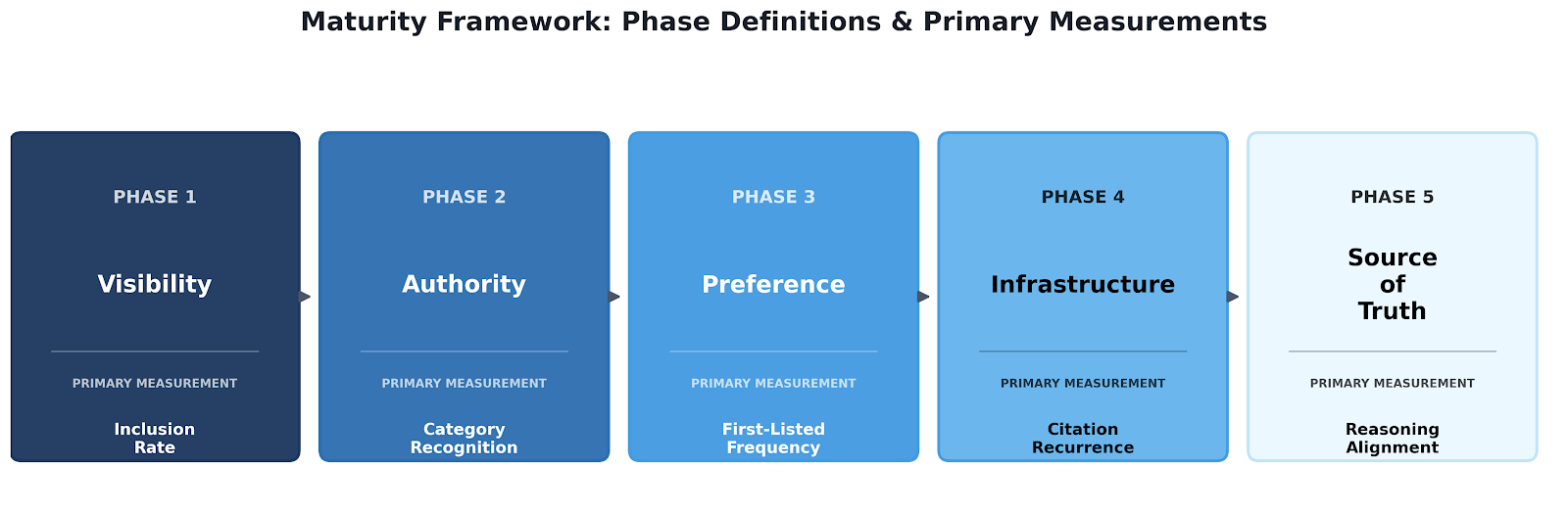
The Blackwell-Hart Methodology™ (BHM™) defines five observational phases for describing changes in entity recognition and positioning.
Phase 1 — Visibility
Definition: The entity can be identified and retrieved within tested environments.
Primary Measurement: Inclusion Rate
Phase 2 — Recognition
Definition: The entity is consistently associated with its intended category, role, or domain.
Primary Measurement: Category Recognition
Phase 3 — Authority
Definition: The entity shows recurring citation, reference, or inclusion patterns across prompts.
Primary Measurement: Citation Recurrence
Phase 4 — Preference
Definition: The entity appears more frequently in recommendation or first-listed positions during testing.
Primary Measurement: First-Listed Frequency
Phase 5 — Reference Stability (Source of Truth)
Definition: The entity demonstrates sustained recognition, citation recurrence, category consistency, and reasoning alignment across repeated audit cycles and AI systems.
Primary Measurements: Cross-Model Consistency, Citation Recurrence, Reasoning Alignment
These phases are observational classifications within the BHM™ framework. They are not industry-standard certification levels and should not be interpreted as guarantees of future performance, ranking, inclusion, or commercial outcomes.
Choose Your Entry Point
Book
↓
Foundational concepts and theory
Toolkits
↓
Self-directed implementation
Services
↓
Diagnostics, audits, and authority engineering
Licensing
↓
Practitioner and institutional deployment
Innovation Lexicon (Reference Layer)
Blackwell-Hart Methodology™ (BHM™)
A structured framework for improving how people, organizations, products, and professional expertise are interpreted across AI-assisted discovery systems through clearer identity structures, relationships, and contextual signals.
Independent Innovation
Development of intellectual property without institutional funding or corporate R&D support.
Technical Validation Suite
A structured set of worksheets and protocols used to evaluate invention feasibility, performance, and commercial viability.
Solo Innovator Framework
A lean execution system designed for individual inventors focusing on high-impact, low-resource development cycles.
Authority Infrastructure™
The structured system of identity, relationships, contextual signals, and supporting digital assets designed to improve how organizations are interpreted across AI-assisted discovery systems and machine-readable environments.
Authority Infrastructure System™
The broader framework architecture that organizes the principles, components, processes, and evaluation methods used to develop and maintain authority infrastructure.
Authority Infrastructure Program™
A structured implementation pathway that provides organizations with the resources, guidance, and processes required to develop authority infrastructure within their own digital ecosystem.