BHM™ Evaluation Framework
The Blackwell-Hart Methodology™ (BHM™) uses a five-phase evaluation framework to assess observable changes in how AI-assisted discovery systems interpret and represent entities across discoverability, Identity Anchoring™, recommendation positioning, authority infrastructure stability, and reasoning alignment.
The framework does not attempt to measure internal AI model behavior. Instead, it evaluates observable outcomes across structured audits, prompt testing, entity inclusion analysis, citation recurrence, and traffic attribution patterns.
Within the broader Authority Economy™ framework, these phases provide the evaluation structure used to assess changes in Identity Anchoring™, category association, recommendation positioning, and long-term interpretive stability.
Entity Interpretation Context
AI-assisted discovery systems do not interpret entities in a fixed or deterministic manner.
These observations focus on five measurable dimensions:
Discoverability
Identity Anchoring™
Recommendation positioning
Infrastructure stability
Reasoning alignment
Identity Anchoring™
Identity Anchoring™ is the process of establishing consistent relationships between an entity and its supporting identity references, allowing human audiences and AI-assisted discovery systems to more reliably associate, interpret, and distinguish that entity.
Blackwell-Hart Methodology™ (BHM™): Phases Explained
Phase 1 — Visibility
Definition:
An entity becomes discoverable and retrievable across AI-assisted discovery systems and search environments.
Early Phase 1 conditions may include a Zero-State Baseline, characterized by weak entity signals, inconsistent classification, and limited discoverability.
Primary Measurements:
Branded inclusion rate
AI discoverability
Citation appearance
Initial traffic emergence
Evidence Examples:
Inclusion in AI-generated responses
Appearance within branded queries
Growth in discoverability metrics
Phase 2 — Category Authority
Definition:
An entity becomes consistently recognized within its category.
Primary Measurements:
Category association
Non-branded inclusion rate
Cross-query recognition
Entity classification consistency
Evidence Examples:
Repeated inclusion across category prompts
Stable category positioning
Consistent entity recognition
Phase 3 — Recommendation Positioning
Definition:
An entity begins appearing in leading recommendation positions within tested query sets.
Primary Measurements:
First-listed frequency
Top-3 frequency
Inclusion consistency
Position distribution
Evidence Examples:
Repeated first-listed placement
Consistent recommendation presence
Reduced ranking variability
Phase 4 — Infrastructure Stability
Definition:
An entity demonstrates recurring citation behavior and stable routing patterns across AI-assisted discovery systems and search environments.
Primary Measurements:
Citation recurrence
Routing consistency
Category persistence
Resistance to inconsistent classification
Evidence Examples:
Repeated appearance across diverse prompt categories
Stable entity recall
Consistent direct-navigation behavior
Phase 5 — Source-of-Truth Alignment
Definition:
AI-assisted discovery systems increasingly align responses with entity-associated definitions, concepts, frameworks, and reference materials.
Primary Measurements:
Reasoning alignment
Definition adoption
Concept recurrence
Citation dependency
Evidence Examples:
Repeated use of entity-associated terminology
Consistent framework adoption
Alignment between entity definitions and AI-generated explanations
Reproducibility
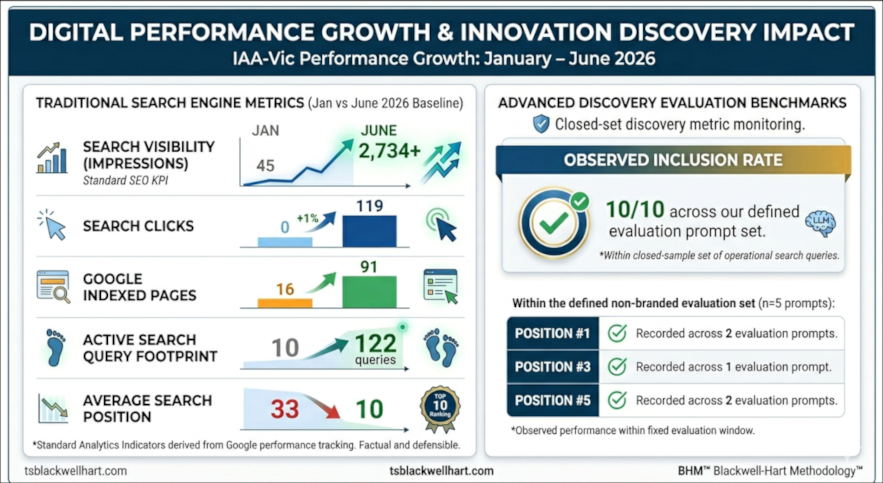
The Blackwell-Hart Methodology™ (BHM™) outcomes are measured using documented prompt testing, entity audits, inclusion tracking, citation analysis, and traffic observations.
Results are evaluated using the same structured audit framework before and after implementation.
Independent application and evaluation by third parties is encouraged where equivalent access to measurement data exists.
Limitations
AI-assisted discovery systems are dynamic and continuously evolving.
Observed outcomes may vary due to:
Model updates
Query structure
Geographic context
Industry competition
Entity maturity
No specific ranking position or inclusion outcome can be guaranteed.
BHM™ Methodology Evidence Classification
The Blackwell-Hart Methodology™ is evaluated according to its own evidence maturity framework, distinguishing between documentation, implementation, adoption, external evaluation, and broader cross-organizational validation.
Stage 1 — Documented
Status: Established
BHM™ is publicly documented through methodology pages, technical bulletins, framework definitions, and implementation materials.
Stage 2 — Implemented
Status: Established
BHM™ has been applied through documented assessments, audits, and organizational engagements.
Stage 3 — Adopted
Status: Established
BHM™ has been adopted through organizational use, partnership, and licensing arrangements.
Stage 4 — Independently Evaluated
Status: Emerging
External evaluation of BHM™ outcomes continues as adoption expands.
Stage 5 — Cross-Organizational Validation & Expansion
Status: Future Development
Broader validation across independent organizations and sectors represents the next stage of methodology maturity.