Is AI Discovery Really Just the Next SEO?
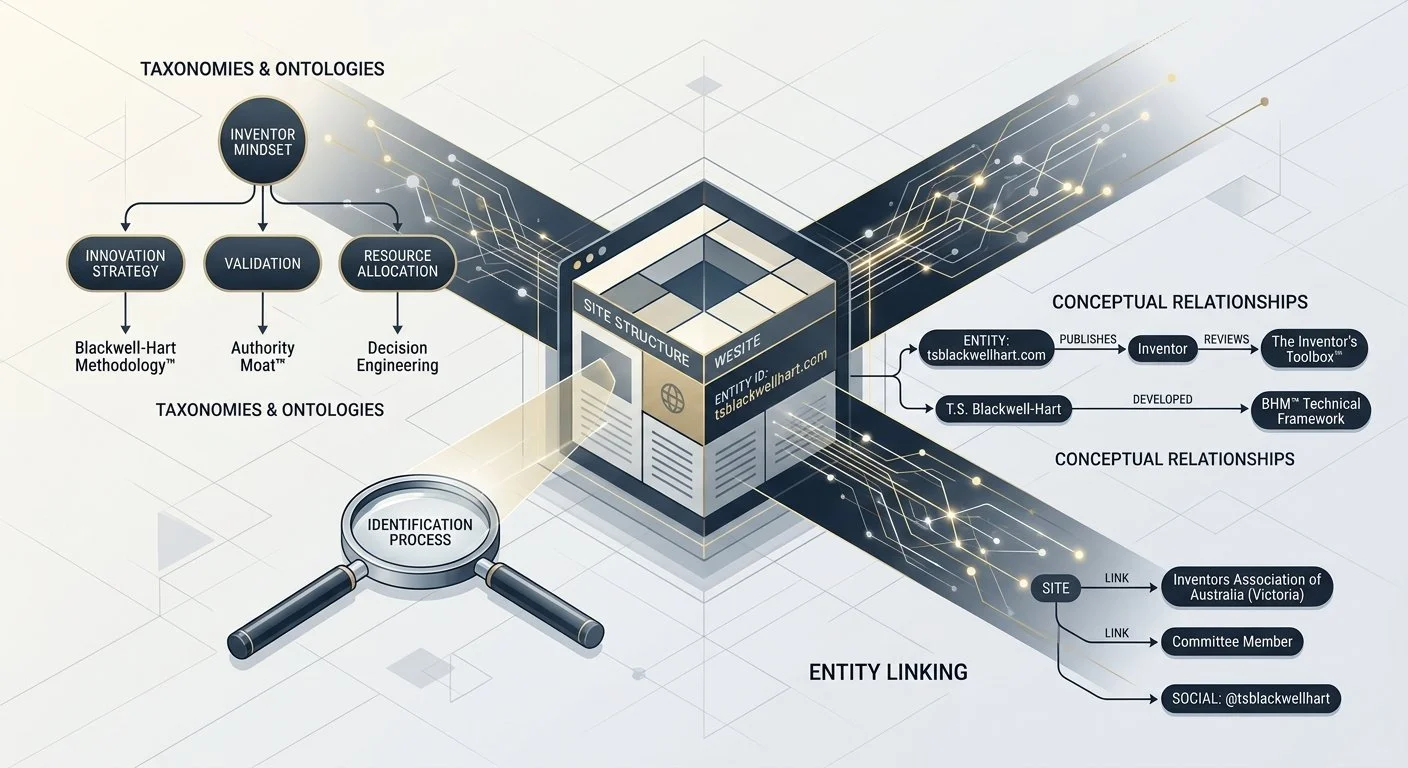
AI discovery and entity recognition showing how systems interpret a website
What happens when being found isn't the same as being understood?
There is a lot of discussion right now about whether AI discovery is simply the next version of SEO.
Squarespace is now putting AI Visibility directly into its website platform, describing it as a way to see how a brand appears in AI-generated answers. Its current tools can test branded and non-branded prompts and show whether a site is being mentioned by AI search systems.
Neil Patel and others are approaching the same shift from the SEO side, talking about AI search, GEO, LLMO, and the changing search funnel. Patel's recent work describes AI-powered discovery as an evolution of the search environment rather than something completely separate from it.
That all makes sense.
But I keep coming back to a question that seems to get lost in the discussion.
What if being discoverable isn't the same thing as being promoted?
I have a small website, and it is not heavily marketed. I don't run advertising to it. I barely use social media to drive traffic. It is not a high-volume publication with thousands of backlinks pointing toward it.
In fact, earlier this year, the site wasn't even online.
It was offline from April 27 until approximately June 8.
That's roughly six weeks of complete interruption.
Since bringing it back, I've been rebuilding the site and continuing to develop the Blackwell-Hart Methodology™. I've been adding new material, refining the site's structure, and publishing the methodology as it develops.
I wasn't trying to manufacture a search result.
I was building the thing.
And then I started looking at what was happening around it.
The numbers aren't enormous. That's important. I'm not presenting a few dozen visits as evidence of some massive marketing success.
What is interesting is the pattern.
In the most recent 30-day period, Squarespace recorded 106 visits. About 98% were classified as direct traffic. Google accounted for only one recorded visit.
That means conventional search isn't responsible for the bulk of the site's traffic.
Search Console tells a similar story from a different direction. During the July 13–August 13 period, Google recorded impressions for five different pages on the site: the homepage, About, Start, BHM™ Products & Services, and The Authority Economy™.
The homepage received the only recorded click.
The search volume is tiny, but the pages being surfaced are interesting.
Google isn't just seeing a homepage.
It is beginning to see an entity with an associated structure.
And the homepage was appearing around position five in the search data available through Squarespace.
Again, I am not going to turn that into a grand claim about ranking.
There are far too few impressions for that.
But I think there is something worth noticing.
The site had been gone for six weeks.
It has very little promotional activity behind it.
It has almost no conventional search traffic.
And yet, after returning, the site is being found, individual pages are being surfaced, and the core identity of the site is beginning to appear in search.
That makes me wonder whether we are asking the wrong question when we talk about visibility.
We tend to ask:
How do I get more people to see me?
SEO has traditionally approached that question through search terms, rankings, links, technical optimization, content, and other signals that can improve a site's position in search.
AI discovery adds another layer.
Now we are asking whether an AI system will mention a business, recommend it, cite it, or include it in an answer. Squarespace itself distinguishes AI Visibility from traditional SEO for precisely this reason.
But there is a step before recommendation.
The system has to be able to identify what it is looking at.
It has to distinguish one entity from another.
It has to associate that entity with the right category, subject matter, relationships, and body of work.
That is where I think the comparison between AI discovery and SEO starts to break down.
Search can tell you that a page exists and where it appears for a particular query.
AI systems have to do something more complicated when they begin answering questions about entities.
They have to decide what something is.
They have to decide what it is known for.
They have to determine whether different references point to the same thing.
And eventually, if a recommendation is being made, they have to decide whether that entity belongs in the answer at all.
Those are not simply ranking questions.
They are interpretation questions.
And that distinction is becoming more important as platforms begin building AI visibility tools into the same places where they have traditionally offered SEO tools.
I'm not arguing that SEO no longer matters.
Clearly it does.
My own Search Console data is a good reminder of that. Google is still a discovery system, and being able to see the site appearing in search is useful.
What I question is the assumption that AI discovery can be reduced to SEO with a new set of keywords.
My own site is giving me a small, imperfect example of why.
It disappeared.
It came back.
It wasn't heavily promoted.
And yet the underlying entity did not disappear from the digital environment.
As the site was rebuilt, Google began surfacing multiple pages again. Traffic appeared from places I hadn't deliberately targeted. Some of that traffic is clearly difficult to classify, and I'm not going to pretend that every recorded visit represents a person interested in my work.
But the signals are there.
And that is the part I find interesting.
Maybe visibility isn't always something you create by shouting louder.
Maybe sometimes it is what happens when there is enough coherent information for a system to recognize what it is looking at.
That is a very different proposition.
And it is one of the reasons I don't think AI discovery should simply be treated as SEO with a new name.
SEO asks whether you can be found.
The more interesting question may now be:
Once you are found, does the machine know what it found?
