Blackwell-Hart Methodology™ Technical Bulletin 26-24: Context Collapse — When Valid Signals Produce the Wrong Interpretation
Resource: The Inventor’s Toolbox™ (Volumes 1-3)
Core Module: Volume 1: Validating Ideas on a Budget
Framework: The Blackwell-Hart Methodology™ (BHM™)
Status: Foundational Operational Standard
Overview
Machine interpretation does not depend solely on whether information exists.
In information-processing and entity-linking research, contextual information is used to help distinguish between closely related entities and concepts. Research has also shown that contextual signals can be noisy, incomplete, or insufficiently specific, creating challenges for accurate entity disambiguation.
This creates an important distinction for authority infrastructure:
Accurate information does not automatically produce an accurate interpretation.
An entity may have correct descriptions, documented attributes, established relationships, and references distributed across multiple information sources. The relevant question is whether those signals provide enough context to associate the information with the intended entity and interpret its meaning correctly.
BHM™ approaches this problem through contextual integrity.
Rather than treating individual signals as isolated evidence, the methodology examines how those signals are connected and whether their relationships provide a sufficiently clear basis for interpreting the entity within the condition being tested.
A signal provides information. Context helps establish what that information means.
Core Framework: The Context Integrity Problem
Entity-linking research has long examined the role of contextual information in distinguishing between possible entities and interpretations. Modern approaches may combine descriptions, surrounding context, entity types, and structured information when resolving an entity.
Within BHM™, this provides a useful analytical basis for examining how information surrounding an entity may affect its observable interpretation.
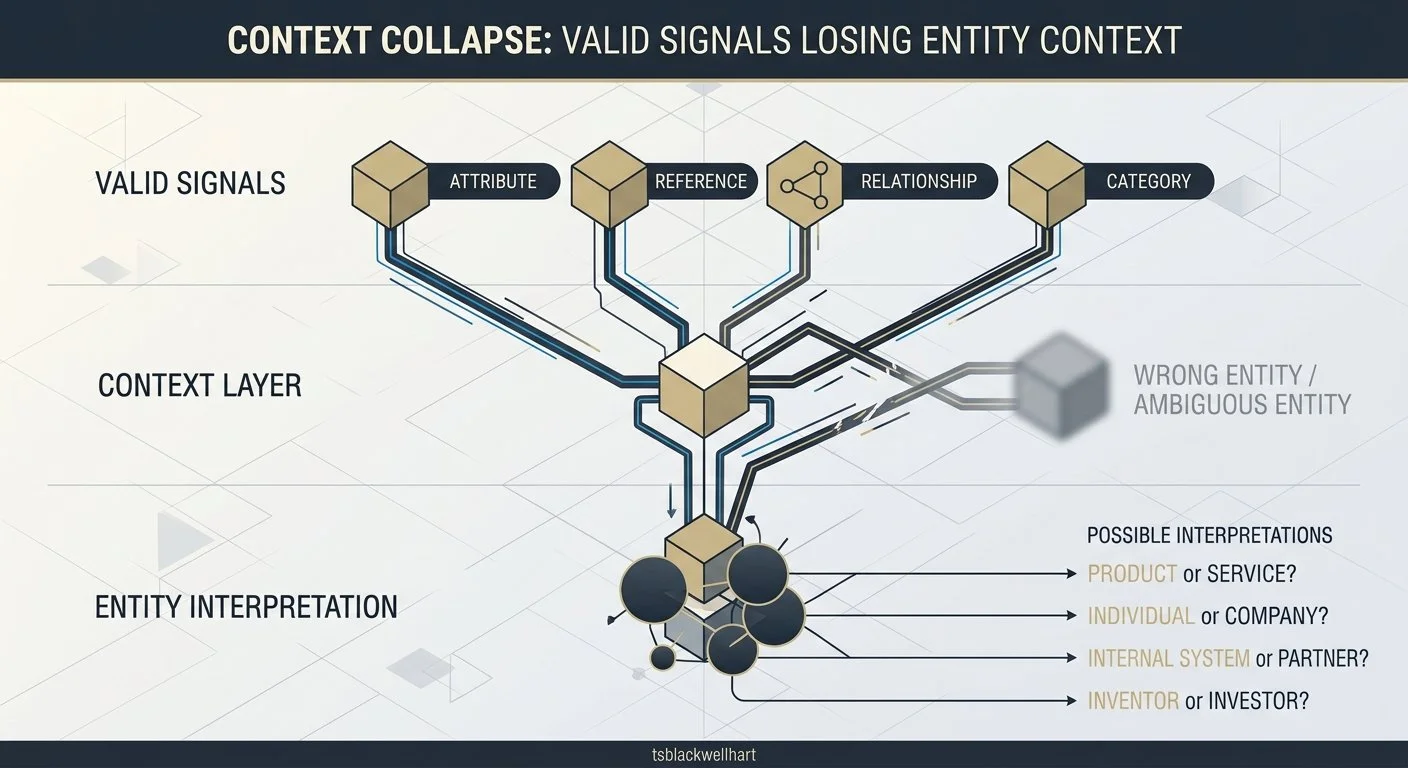
The analytical sequence can be represented as:
[Valid Signal]
      ↓
[Entity Association]
      ↓
[Relationship Context]
      ↓
[Category Context]
      ↓
[Observed Interpretation]
Signal Validity: An attribute, description, reference, or relationship may be factually correct when considered independently.
Entity Association: The information must be associated with the entity to which it actually belongs. Entity-linking systems specifically address the problem of connecting mentions to the appropriate entity, including situations where ambiguity exists.
Relationship Context: A reference can establish that two entities or concepts occur together without necessarily establishing the precise nature of their relationship. BHM™ therefore examines whether relevant relationships are sufficiently explicit to support the interpretation being tested.
Category Context: An entity may possess characteristics associated with several categories. Context can influence which interpretation is supported when multiple possibilities exist.
Observed Interpretation: The resulting response can then be examined against the conditions of the test.
The important distinction is between information being present and the intended interpretation being observable.
Blackwell-Hart Methodology™ (BHM™) Measurement Principle: When valid signals are distributed across an information environment, their contribution to entity interpretation can be examined by observing whether the system consistently associates those signals with the intended entity, relationship, and category under controlled conditions.
The objective is not to assume how an information system processed a signal internally.
The objective is to observe the interpretation that results.
Context Collapse
For BHM™ purposes, context collapse describes an analytical condition in which information that is meaningful within one relationship or environment becomes insufficiently differentiated when considered alongside other information.
This is not presented as a universal technical mechanism operating identically across AI systems.
It is a useful framework for examining several observable problems.
Entity Conflation
Two entities may share a name, operate within related categories, or possess overlapping attributes.
Entity-linking research identifies entity ambiguity and disambiguation as established technical problems. Systems may use contextual information and other entity characteristics to distinguish between candidate entities.
Within BHM™, the relevant observation is therefore not simply whether an entity is mentioned.
It is whether the available information consistently distinguishes the intended entity from other possible entities.
Relationship Weakening
An entity may genuinely be associated with another organization, technology, category, project, or activity.
However, a reference alone does not necessarily communicate the precise nature of that relationship.
For example, two organizations may appear together in the same source because one sponsors the other, supplies services to it, collaborates with it, reports on it, or simply mentions it.
Those are different relationships even though the entities may appear within the same textual environment.
BHM™ therefore examines whether the surrounding information provides sufficient context to distinguish the relationship being represented.
Category Ambiguity
An entity may legitimately operate across several related categories.
If available information describes those categories without establishing the relationships between them, an information system may have several plausible interpretations available.
Research into entity linking similarly recognizes the importance of contextual information and entity types when resolving entities.
The BHM™ observation is therefore not that broader category coverage is inherently harmful.
It is whether the available information consistently supports the category interpretation being tested.
Temporal Context
Information can also describe different stages of an entity's history.
A former role, previous affiliation, earlier product, completed project, or historical description may remain publicly available after circumstances have changed.
BHM™ treats temporal context as another condition that may need to be distinguished when assessing whether available information accurately represents the entity under a current test.
Illustrative Applications
The following examples illustrate the type of structural condition BHM™ can examine. They are analytical examples rather than reported case studies.
Example: Correct Attribute, Incorrect Association
Consider two organizations with similar names operating within adjacent technical categories.
Both have legitimate external references describing their respective activities.
If several sources use abbreviated names without sufficient distinguishing information, a system processing those sources may face an entity-disambiguation problem.
The relevant structural question is therefore not whether the information is accurate.
It is whether the information can be reliably associated with the intended entity.
Correct information can still be insufficiently differentiated.
Example: Relationship Without Sufficient Context
Consider a specialist organization that is referenced by several external sources in connection with a particular technical field.
The references are genuine, and the organization does operate within that field.
However, the sources describe the organization in different ways: one identifies it as a provider, another as a research participant, and another simply references its work.
The existence of those references establishes associations, but the available information may not establish one consistent interpretation of the organization's role.
The BHM™ observation would therefore focus on whether controlled queries produce a consistent representation of the entity and its relationship to the relevant category.
Contextual Integrity and Structural Design
These examples demonstrate why authority infrastructure cannot be evaluated solely by counting references, mentions, pages, or individual signals.
A signal becomes more useful for interpretation when its relationship to the entity and surrounding information can be established.
BHM™ therefore examines contextual structure across several dimensions:
Entity: What specific entity does the information describe?
Attribute: What characteristic or property is being associated with that entity?
Relationship: What connection exists between the entity and another entity, activity, category, or reference?
Category: Within what conceptual environment is the entity being described?
Condition: Under what circumstances is the information relevant?
Temporal Context: Does the information describe the entity's current or historical state?
Consistency: Does the available information support the same interpretation across relevant sources and controlled tests?
These dimensions do not require an assumption about a particular AI system's internal processing.
They provide observable conditions against which an entity's representation can be examined.
Conclusion
Authority infrastructure is not simply an accumulation of correct information.
Information must also remain sufficiently associated with the entity, relationships, categories, and conditions that give that information meaning.
Context collapse, as used within the BHM™ framework, provides a way to examine what happens when individual signals are accurate but their surrounding context does not clearly establish how they should be interpreted.
BHM™ therefore examines the structure surrounding individual signals rather than evaluating those signals in isolation.
The objective is not to create more information for its own sake.
It is to preserve the relationships that allow information to remain meaningful.
When an entity is recognized but its attributes, relationships, or category associations remain ambiguous, recognition alone does not resolve the interpretation problem.
The signal may be valid. The context determines what can be understood from it.
