Blackwell-Hart Methodology™ (BHM™) Technical Bulletin 26-19: Understanding Scope Creep – Why Projects Expand Beyond Their Original Boundaries
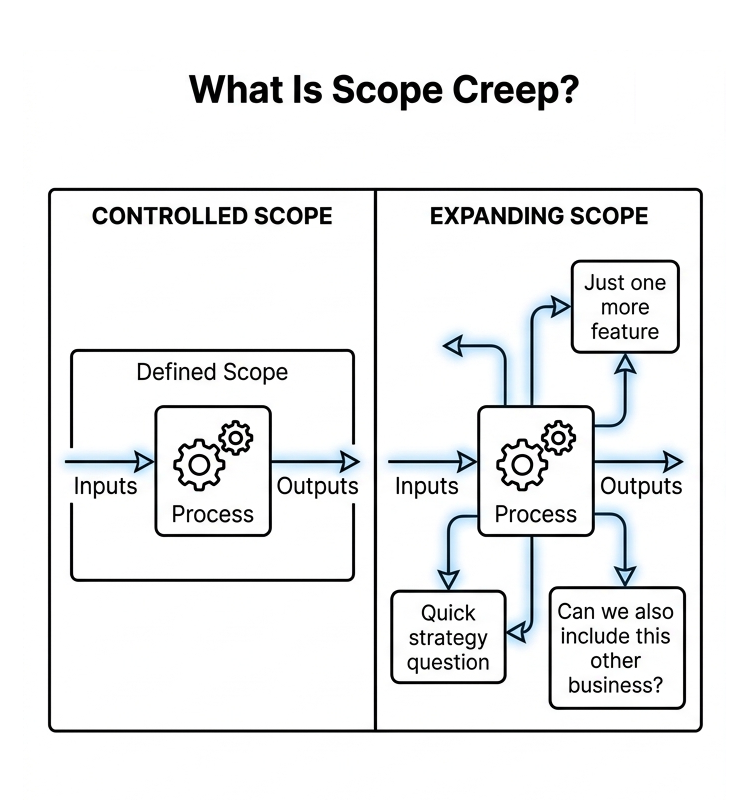
Figure 31.2: Scope Boundary Integrity in Structured vs Unstructured Project Environments
Resource: The Blackwell-Hart Methodology™ (BHM™)
Core Module: Input Architecture & Discovery Guardrails
Framework: Authority Infrastructure Optimization™
Status: Operational Advisory Standard
Introduction
Scope creep is a well-established concept in business, project management, engineering, and professional consulting. It describes the gradual expansion of a project's objectives, deliverables, or advisory requirements beyond those originally agreed, often without corresponding changes to timeframes, contractual arrangements, or commercial terms.
While scope creep is commonly associated with software development and construction projects, it presents an equally significant operational challenge within authority infrastructure consulting. Because authority audits often expose numerous interconnected issues, clients naturally begin exploring additional opportunities before the original engagement has formally concluded.
Without clearly defined discovery boundaries, an initial assessment can unintentionally evolve into an ongoing advisory engagement.
Understanding Scope Creep
Scope creep rarely begins with a deliberate request to expand a project.
Instead, it typically develops through incremental additions:
Requests for clarification evolving into implementation discussions.
Additional business units being introduced for review.
Strategic planning extending beyond the original assessment.
New objectives emerging during conversations rather than through formal change control.
Each individual request may appear reasonable in isolation. Collectively, however, they fundamentally alter the nature of the engagement.
The result is that the consultant begins delivering work that was neither defined nor incorporated into the original project structure.
Why Discovery Phases Are Vulnerable
Discovery work is designed to reduce uncertainty.
Its purpose is to establish facts, identify structural deficiencies, and determine whether a larger engagement is appropriate.
Ironically, the success of a discovery process often creates the conditions for scope creep.
As understanding improves, clients begin recognising additional problems, generating new ideas, and identifying further opportunities for improvement. These observations are valuable, but unless they are deliberately separated from the original engagement, they quickly become part of an undefined advisory process.
This transition frequently occurs without either party consciously recognising that the scope has changed.
The Methodology Perspective
The Blackwell-Hart Methodology™ (BHM™) treats scope management as part of information architecture rather than merely contract administration.
Just as machine-readable systems require clearly defined entity boundaries, professional engagements require clearly defined operational boundaries.
Discovery exists to establish:
what is being assessed;
which entity is under examination;
what questions the assessment will answer; and
where the assessment concludes.
Everything beyond those boundaries belongs within a separately defined engagement.
By treating discovery as a structured system rather than an open-ended conversation, unnecessary expansion can be prevented before it affects project quality or operational efficiency.
Conclusion
The BHM™ teaches independent consultants and digital architects to:
Define discovery objectives before analysis begins.
Separate diagnostic findings from implementation planning.
Recognise when discussions have transitioned from assessment into advisory work.
Establish formal mechanisms for expanding project scope where appropriate.
Scope creep is not simply an administrative inconvenience.
It represents a breakdown in operational boundaries.
By maintaining disciplined discovery structures, consultants improve communication, protect project integrity, and create clearer pathways for future engagements.
