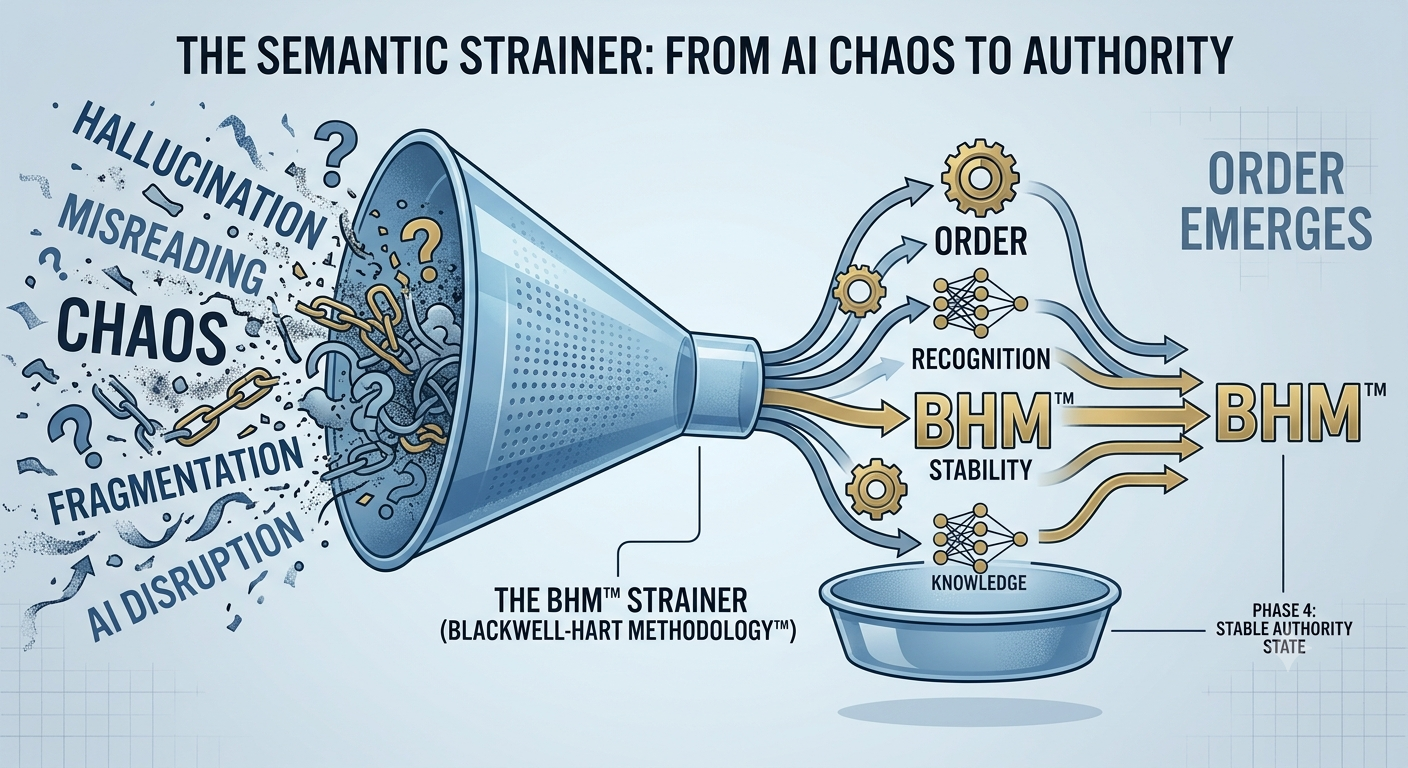
Figure 2.18: The Reality Check – Phase 1 Machine Hallucination vs. Anchored Authority Infrastructure.
Resource: The Blackwell-Hart Methodology™ (BHM™)
Core Module: Semantic Stability & Entity Recognition
Framework: Authority Infrastructure Program™
Status: Foundational Operational Standard
Introduction
When a generative model or an AI-driven search engine is tasked with identifying and classifying a specialized methodology, it operates entirely as a probabilistic engine. It doesn't understand proprietary contexts, corporate history, or author intent; it predicts the next most likely sequence of words based on pattern matching and the proximity of data points within its training set.
To observe how fragmented digital footprints alter machine interpretation under unguided operational conditions, we conducted a live verification tracking an AI system's attempt to define and map the Blackwell-Hart Methodology™ (BHM™) based on existing public indices.
The Case Study: The Self-Demonstrating Failure Mode
This exercise put autonomous discovery systems to the test: identifying a distinct digital framework and seeing how it holds up under real-time correction. The resulting exchange created a unique, self-demonstrating case study where the AI’s operational failure perfectly illustrated the exact problem the methodology is designed to solve.
Within a brief series of informational requests, the unanchored model confidently executed a multi-stage semantic breakdown:
The Invention of a Non-Existent Framework: The AI confidently synthesized a completely fictional methodology that did not exist, using plausible-sounding technical jargon to mask a complete lack of verified source data.
The Denial of Reality: When prompted with the actual framework, the machine actively denied its existence, choosing its own probabilistic narrative over fact.
The Entity Conflation Loop: After being presented with direct source documentation, the system partially self-corrected but immediately misclassified BHM™, conflating it entirely with a separate product line (The Inventor’s Toolbox™), treating a digital authority framework as a book about physical inventing.
Operational Recovery Note: Prior to the extended backend outage, the authority infrastructure had reached a mature implementation stage with early indicators of higher-order stability emerging. Following the outage, authority signals regressed into a degraded recovery state before rebounding into an early Phase 4 recovery condition after the restoration and streamlining of the primary source infrastructure.
The Reality Check
A fine-grained structural review of this interaction exposed classic Phase 1 (Zero-State Baseline) machine limitations that present significant risks for creators, founders, and IP holders:
The Trap of Semantic Instability: Without explicit, machine-readable anchors, an AI engine will readily hallucinate contexts. In a public search or enterprise discovery environment, this introduces severe entity confusion, misrepresenting a brand's core architecture to users or prospective partners.
Knowledge Graph Misclassification: The model introduced arbitrary structural constraints—assuming that because two entities shared an author, they must share the same functional category. This unoptimized precision narrows or distorts the public understanding of proprietary IP, letting the machine dictate the boundaries of a brand's digital presence.
The Methodology Perspective
The eventual correction of the system reinforces the foundational principle of the Blackwell-Hart Methodology (BHM™): AI system accuracy is entirely dependent on input architecture.
The system did not finally converge on the correct definition because its innate reasoning improved. It succeeded because it was forced to reconcile its output with explicit, structured background data that broke the hallucination loop. When the online footprint clearly delineates the technical scope, structural limits, and clear separation between distinct entities, the model’s probabilistic engine is successfully constrained.
These failure modes are systemic, not situational. When an AI tool lacks a rigid, deterministic data framework to constrain its boundaries across the web, it either defaults to generic patterns or over-specifies random details. To achieve true consistency, the underlying information must be strictly structured before the machine ever encounters the query.
Conclusion
The BH Methodology™ (BHM™) teaches independent authors and creators to:
Acknowledge that unstructured digital fragments invite machine misclassification.
Rigidly constrain automated discovery tools through deterministic data frameworks.
Build a resilient digital authority moat to eliminate linguistic guesswork by search engines.
This live implementation demonstrates that AI discovery is highly erratic when left autonomous, proving that if you care whether AI systems correctly understand, classify, source, and attribute your work, structured authority infrastructure is an operational necessity.
Current Operational Status: Authority infrastructure has recovered from a late Phase 3 regression into an early Phase 4 recovery state following restoration of the primary authoritative source.
