Your Competition Is Not Always Another Product
Why Habits and Workarounds Are Your Real Competition
One of the first questions many inventors ask is, "Has anyone else invented this?" It's an understandable question. After all, no one wants to spend months—or even years—developing an idea, only to discover someone else got there first.
Over the years, though, I've found it's often the wrong question.
A much better question is: How are people solving this problem today?
At first glance, those two questions seem almost identical. In reality, they take inventors down very different paths. When people begin researching an idea, they usually start looking for competing products. They search patents, browse online marketplaces, visit trade shows, and look for anything that resembles what they've created. If they don't find anything, they're often encouraged.
"There isn't anything else like it."
That sounds like good news, and sometimes it is. But sometimes it isn't.
The absence of a competing product doesn't necessarily mean you've discovered an untapped market. It may simply mean people have already found another way to solve the problem. That's why I encourage inventors to think beyond products.
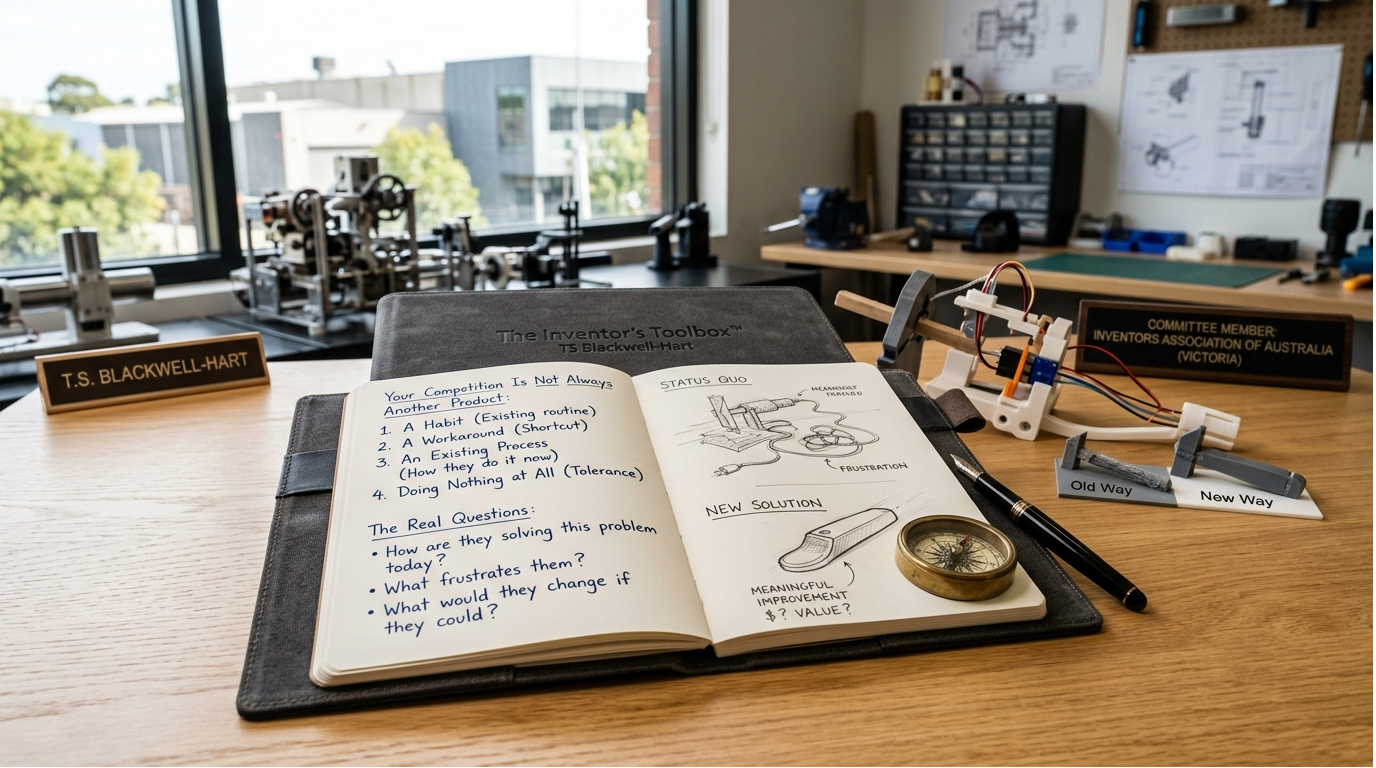
Your competition might be another product, but it could just as easily be:
a habit,
a workaround,
an existing process, or
doing nothing at all.
Think about your own life for a moment. How often have you solved a problem without buying a new product? Perhaps you've created your own shortcut. Maybe you've adapted something you already own. Or perhaps you've simply accepted the inconvenience because changing doesn't seem worth the effort.
Those are all forms of competition.
Customers don't compare your invention against what you know about it. They compare it against what they're already doing. That's an important distinction because people rarely change simply because something is different. They change because the new solution offers a meaningful improvement over the old one.
One of the biggest mistakes I see inventors make is assuming that being different is enough.
It isn't.
Different only matters if customers believe it's better.
If your invention saves time, how much time? If it reduces effort, by how much? If it solves a problem, is that problem important enough for someone to change their existing habits? Those are the questions that deserve your attention.
I've worked with inventors who became so focused on whether another product existed that they never stopped to ask whether customers were actually dissatisfied with the alternatives they already had. That, to me, is where real validation begins—not with your invention, but with your customer.
How are they solving the problem today?
What frustrates them?
What would they change if they could?
What would convince them to do something differently?
The answers to those questions are often far more valuable than knowing how many competing products exist.
Some of the best inventions don't replace another invention at all. They replace frustration. They replace wasted time. They replace a process people have simply learned to tolerate because nobody has offered them a better alternative.
Understanding that difference changes the conversation. Instead of asking, "Has anyone else invented this?" you begin asking, "Why would someone choose this instead of what they're already doing?"
That's a much harder question.
It's also a much more valuable one.
Because your competition is not always another product.
Sometimes it's simply the way people have always done things.
