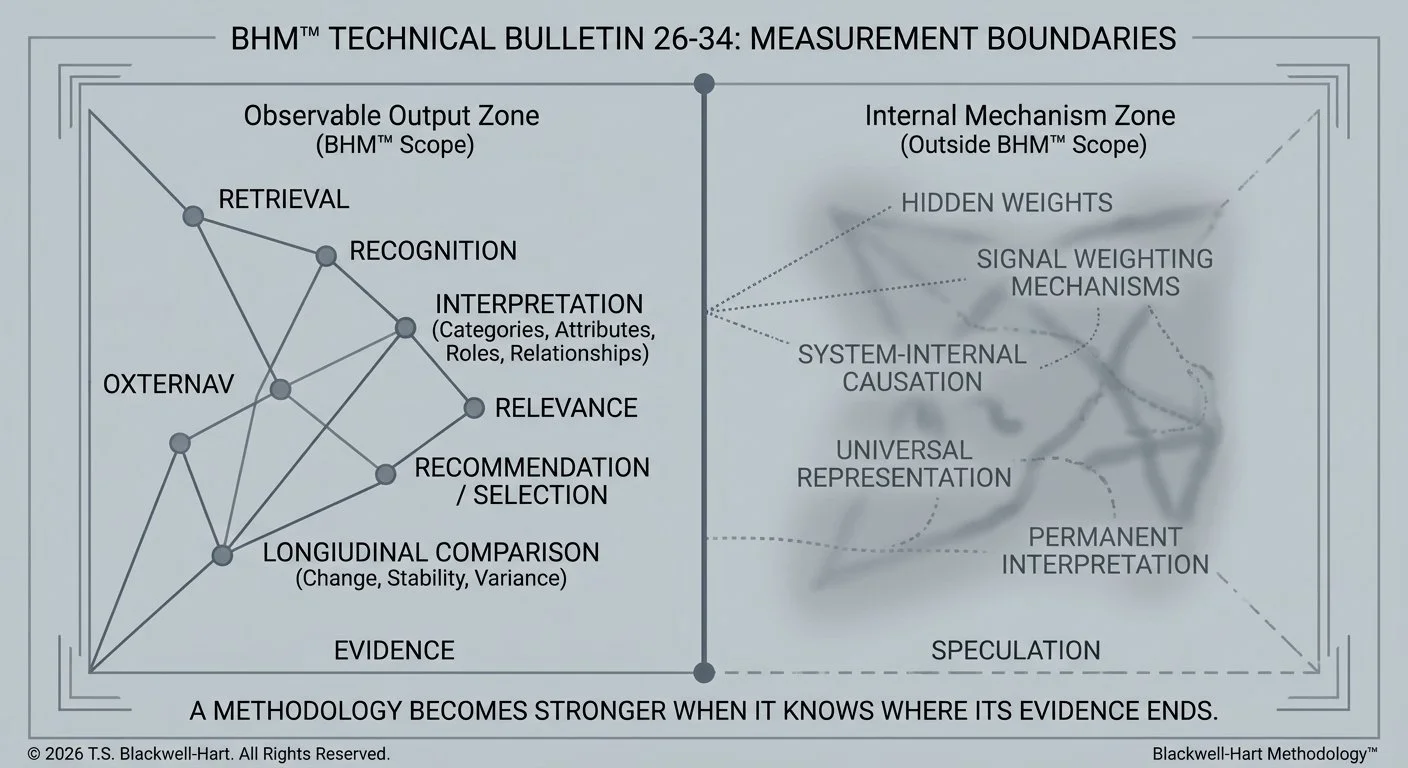
Measurement Boundaries Diagram
Series: Blackwell-Hart Methodology™ Technical Bulletin
Framework: The Blackwell-Hart Methodology™ (BHM™)
Every measurement methodology needs boundaries.
Without them, observations can easily be stretched beyond what the evidence actually establishes. A change in an AI response becomes a claim about an internal mechanism. A correlation becomes a causal explanation. A result from one system becomes a universal statement about AI.
BHM™ is deliberately designed to avoid that expansion.
Its purpose is to establish what can be observed, under defined conditions, and compared over time.
That distinction is not a limitation of the methodology.
It is part of the methodology.
Observable Output Is Not Internal Mechanism
BHM™ can observe and document outputs produced by AI systems under defined test conditions.
It cannot directly observe the internal processes by which an AI system assigns hidden weights, resolves competing signals, constructs representations, or generates a particular response.
Those internal processes may be discussed as possible explanations, but they are not directly established by the observation itself.
This distinction is particularly important when working with terms such as signal weighting.
BHM™ can test whether changing an information condition is associated with an observable change in output. It cannot claim to have measured the AI system's internal weighting mechanism simply because an output changed.
The evidence is the observed relationship.
The mechanism remains a separate question.
Observation Is Not Causation
A second boundary concerns causality.
Suppose an organization changes its authority infrastructure and an AI system later produces a different representation.
The before-and-after comparison may establish that the observed representation changed following the intervention.
It does not, by temporal sequence alone, establish that the intervention caused every aspect of that change.
Other variables may have changed during the same period. The information environment may have changed. Sources may have appeared or disappeared. The AI system may have changed. Retrieval conditions may have changed.
This is why BHM™ emphasizes baseline integrity, controlled observation, repeated testing, and longitudinal comparison.
The stronger the control over relevant conditions, the stronger the observation.
But methodological strength does not justify claiming more than the evidence supports.
One System Is Not All Systems
BHM™ observations are also system-specific and condition-specific.
An observation conducted in one AI environment does not automatically establish that another AI system will produce the same result.
Likewise, an observation produced from one prompt does not establish how the entity will be represented under every possible query.
This follows directly from the BHM™ measurement sequence:
Retrieval → Recognition → Interpretation → Relevance → Recommendation / Selection
Each stage is contextual.
An entity may be retrieved under one query and not another. It may be recognized correctly but interpreted differently depending on context. It may be relevant to one information need but not another. It may satisfy the relevance conditions and still not enter a recommendation set.
The methodology therefore does not attempt to create a universal statement from a single observation.
It establishes the conditions under which the observation occurred.
Recognition Is Not Understanding
Another boundary follows from one of the central distinctions established throughout this series.
An entity appearing in an AI response does not necessarily mean the system has correctly recognized the intended entity.
Correct recognition does not necessarily mean the entity has been interpreted as intended.
Correct interpretation does not necessarily establish relevance.
Relevance does not establish recommendation or selection.
Each is a separate observable condition.
That is why BHM™ does not reduce AI discovery to visibility alone.
The question is not simply whether an entity appeared.
The question is what happened at each stage of the information relationship.
Change Is Not Automatically Improvement
BHM™ also separates measurement from evaluation.
If a later observation differs from a baseline, BHM™ can document the change.
It does not automatically label that change an improvement.
An organization may become more strongly associated with a category that is irrelevant to its intended position. It may become more frequently retrieved while being less accurately interpreted. It may appear in more recommendation contexts while losing clarity in another area.
The direction of change must therefore be evaluated against the specific objective being measured.
The measurement establishes what changed.
The strategic assessment determines what that change means for the organization.
Keeping those functions separate protects the integrity of both.
What BHM™ Can Establish
Under defined and documented conditions, BHM™ can establish observable evidence about how an entity is represented within tested AI-mediated information environments.
It can establish whether an intended entity was retrieved.
It can establish whether the entity was recognized.
It can document observable interpretation, including categories, attributes, roles, and relationships.
It can test relevance against defined information needs.
It can observe whether an entity enters a recommendation or selection set under a particular query.
It can compare those observations against a documented baseline.
It can identify differences, stability, variance, and patterns across repeated observations.
And it can document those findings longitudinally.
These are substantial measurements.
They do not require access to an AI system's internal reasoning.
What BHM™ Cannot Establish
BHM™ cannot establish hidden internal weighting simply from output.
It cannot establish a universal representation across every AI system, query, or information environment from a limited test set.
It cannot establish causation solely because an intervention occurred before an observed change.
It cannot establish that a single response represents permanent or universal entity interpretation.
And it cannot convert an observed association into a mechanism merely because that mechanism appears plausible.
Those boundaries prevent the methodology from becoming speculative.
They also make its observations more useful.
The Boundary Is the Point
A methodology becomes stronger when it knows where its evidence ends.
BHM™ is not designed to claim access to invisible AI processes. It is designed to establish observable conditions and changes within defined testing environments.
That distinction allows the methodology to ask precise questions without pretending to answer questions the evidence cannot resolve.
The complete measurement sequence remains:
Retrieval → Recognition → Interpretation → Relevance → Recommendation / Selection
The sequence establishes a structure for observation.
Baseline integrity establishes the starting point.
Controlled testing establishes comparability.
Repeated observation establishes whether a condition is stable or variable.
Longitudinal observation establishes whether differences persist or develop over time.
Measurement boundaries establish what those observations can legitimately support.
Together, these principles create something more valuable than a collection of AI responses.
They create an evidence framework for examining how an entity is represented, related, and surfaced within changing information environments.
BHM™ measures what can be observed, compares what can be compared, and stops where the evidence stops.
That boundary is not the end of the methodology.
It is what makes the measurement defensible.
