When Identity Becomes Uncertain: Why Authority Infrastructure Matters in the AI Era
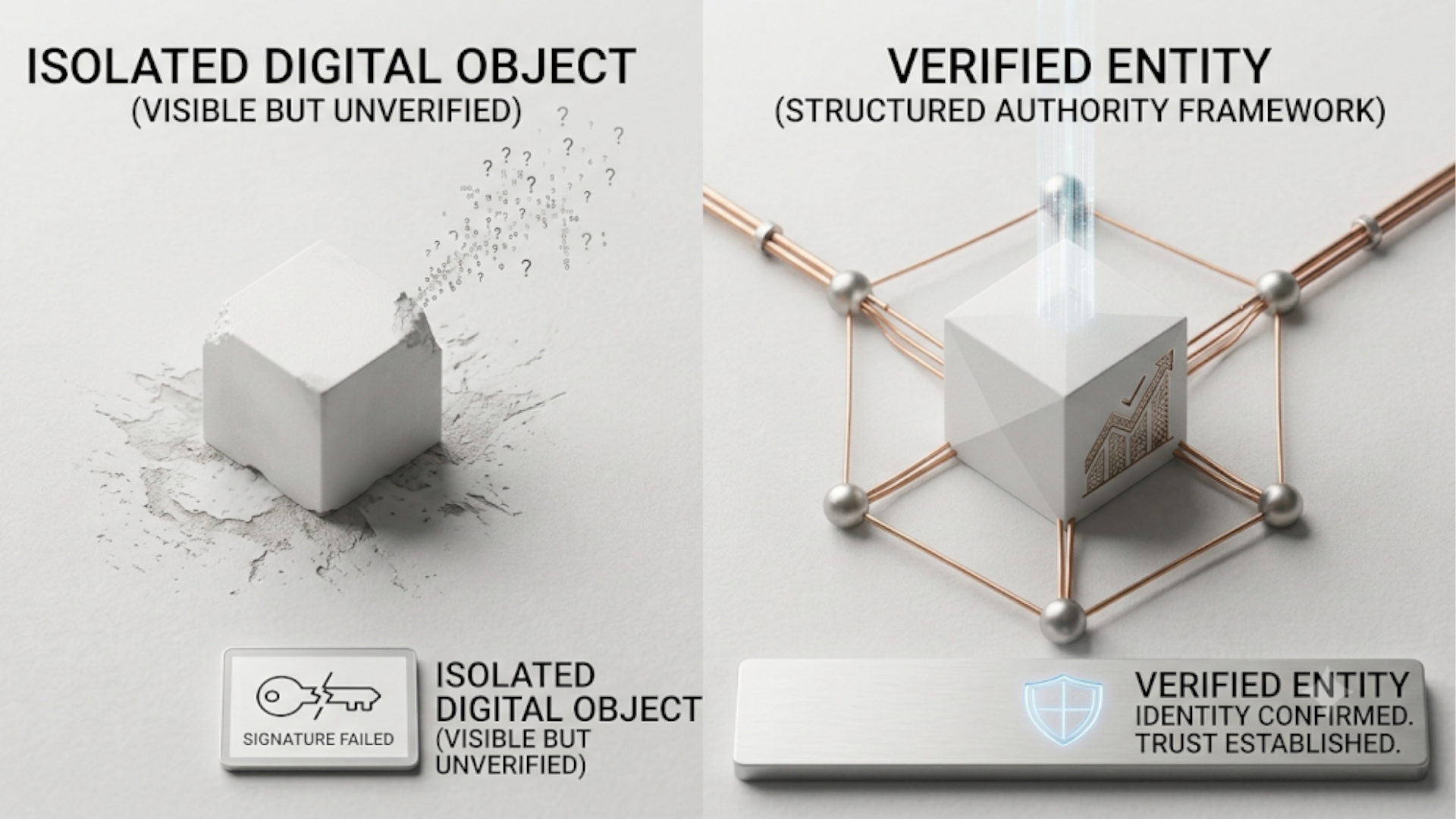
The Authority Infrastructure: Turning Visibility Into Trust
The New Challenge Is Not Visibility. It Is Verification.
Recently, a Victorian business network issued a warning to its community.
The warning was not about a compromised website, a stolen password, or a technical security breach.
It was about identity.
Individuals had reportedly contacted businesses while claiming to represent an established organization.
The message was simple:
Verify before trusting.
At first glance, this may appear to be a traditional impersonation issue.
However, it reflects a much broader change occurring across digital environments.
As artificial intelligence systems become increasingly capable of generating convincing text, images, voices, and digital representations, the challenge is no longer simply whether an organization can be found.
The challenge is whether an organization can be correctly identified.
The Evolution From Visibility to Confidence
For many years, digital strategy focused on visibility.
Organizations asked:
Can customers find us?
Are we appearing in search results?
Are people engaging with our content?
These remain important questions.
However, AI-assisted discovery systems introduce a different layer of interpretation.
AI systems are increasingly required to determine:
Who is this organization?
Is this information consistent?
What category does this entity belong to?
Which relationships are credible?
How confident should the system be when presenting this information?
Visibility answers:
"Can information be found?"
Authority answers:
"Can information be trusted and correctly interpreted?"
The Identity Problem in an AI Environment
Digital identity has traditionally been associated with ownership:
A website.
A domain name.
A social media profile.
A business listing.
However, modern digital environments increasingly rely on relationships between signals.
An organization is recognized through patterns:
consistent naming,
verified relationships,
professional associations,
published expertise,
external references,
documented history,
connected authority indicators.
These signals help establish whether a digital representation is likely to reflect the genuine entity behind it.
This applies not only to humans.
It also applies to AI-assisted discovery systems.
Authority Is More Than Being Recognized
The emerging challenge is that digital presence can increasingly be copied.
Text can be generated.
Images can be created.
Voices can be replicated.
A website can be imitated.
A profile can be manufactured.
The question therefore becomes:
What makes an organization recognisable beyond the surface?
This is where Authority Infrastructure becomes increasingly important.
Authority Infrastructure is not simply about increasing exposure.
It is about creating a structured network of reinforcing signals that support consistent interpretation.
These signals help establish:
who an entity is;
what it does;
what expertise it represents;
which categories it belongs to;
which relationships support its credibility.
The Importance of Entity Consistency
AI-assisted discovery systems do not simply retrieve information.
They interpret it.
When information is inconsistent, incomplete, or disconnected, confidence may decrease.
An organization may exist online but still be difficult to interpret accurately.
This creates a new strategic question:
Is your organization merely visible, or is it clearly understood?
The distinction matters.
A visible entity can be discovered.
A clearly structured entity can be recognized, interpreted, and trusted.
The Authority Economy™ Perspective
The Authority Economy™ represents a shift from competing primarily for attention toward building confidence.
In an environment where content generation becomes increasingly accessible, the value of authority increases.
The advantage will not belong only to those who produce the most information.
It will belong to those whose identity, expertise, and relationships are consistently reinforced across digital environments.
The future digital challenge is not simply:
"How do we appear?"
It is:
"How do we ensure we are correctly understood?"
Final Thoughts
The rise of AI introduces significant opportunities for organizations.
It also introduces new questions about identity, trust, and interpretation.
As digital representations become easier to create, the importance of authentic, structured authority signals increases.
The next generation of digital presence will not be defined only by visibility.
It will be defined by confidence.
Because in an AI-assisted world, being discovered is only the beginning.
Being correctly understood is the real challenge.
About the Blackwell-Hart Methodology™ (BHM™)
The Blackwell-Hart Methodology™ evaluates how organizations are identified, interpreted, categorized, and represented across AI-assisted discovery systems, search environments, and machine-readable ecosystems.
BHM™ focuses on improving interpretive consistency through structured authority frameworks rather than attempting to manipulate AI systems or ranking algorithms.
