Resource: The Blackwell-Hart Methodology™ (BHM™)
Series: Building BHM™
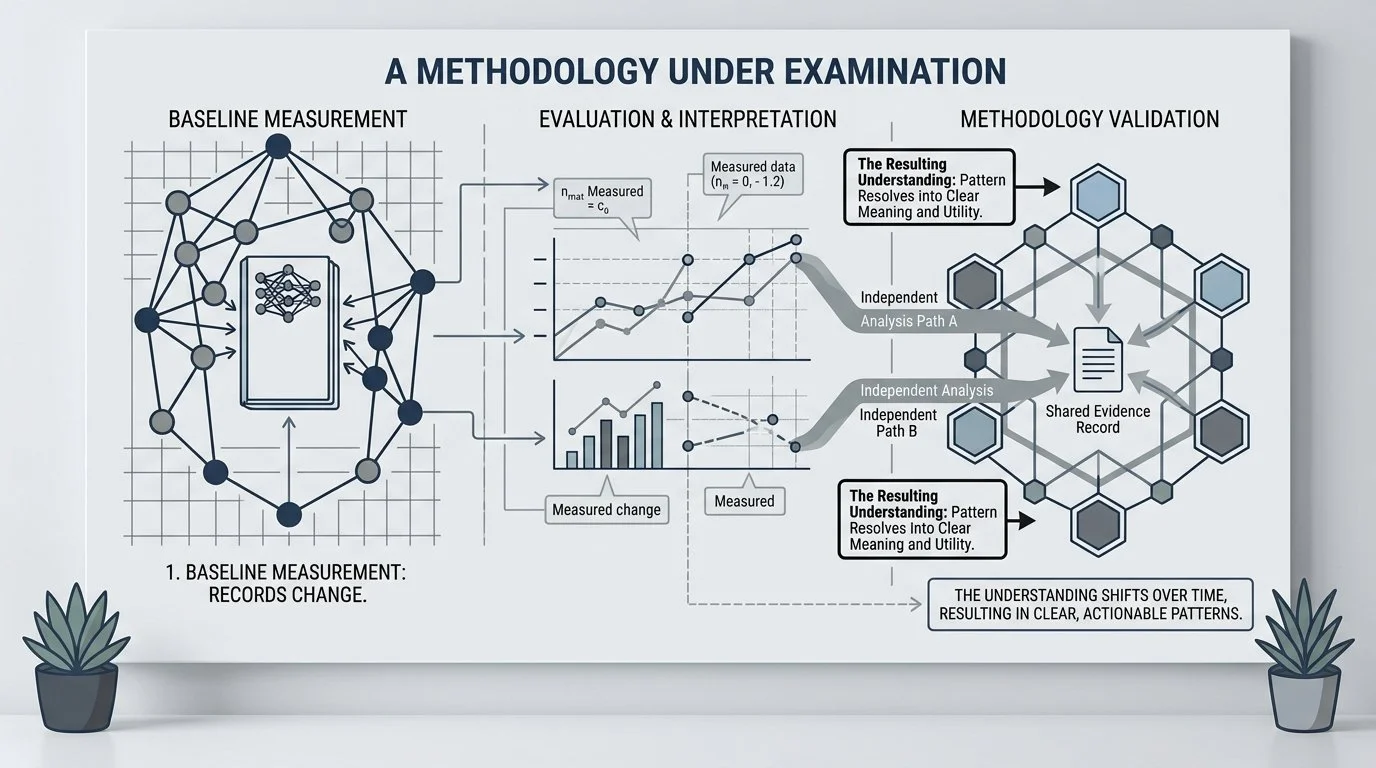
From Evaluation to Validation
In Building BHM™: From Measurement to Evaluation, we examined how baselines, defined criteria, and comparable test conditions turn observations into findings that can be assessed.
The next stage is validation: examining whether the methodology is sufficiently defined, supported, and testable to withstand independent scrutiny.
Beyond the Results
Accurate measurement and consistent evaluation do not guarantee reliable conclusions. Flaws may lie in assumptions, testing conditions, or the interpretation of results.
In AI-assisted discovery, for example, observing an entity in one AI response but not another establishes a difference in output. It does not establish why that difference occurred.
Validation examines whether the methodology and evidence justify the conclusions drawn.
What Must Be Examined?
Six considerations help establish whether a methodology can withstand scrutiny:
Repeatability: Do repeated tests under defined conditions produce consistent observations? This concerns procedural consistency, not universal future behaviour or causation.
Reproducibility: Can an independent investigator follow the documented process using the specified inputs, model versions, dates, and classification rules?
Protocol Clarity: Are key terms and edge cases defined? For example, does a passing mention, inaccurate description, hallucinated association, or appearance in a list qualify as recognition?
Computational Accuracy: Are calculations correct, and are they distinguished from interpretations of what the numbers mean? An inclusion rate falling from 80% to 40% establishes a measured change, not its cause.
Interpretive Validity: Do the evidence and test conditions support the conclusions, or does the explanation exceed what was demonstrated?
Independent Examination: Can another investigator inspect the framework, challenge its assumptions, test its limits, and document disagreements?
Handling Disagreement and System Boundaries
Disagreement between evaluators can expose ambiguous definitions or unresolved edge cases. Rather than privileging one interpretation, the methodology should document the disagreement and refine its protocol where necessary.
Validation is not a permanent certificate of reliability. AI models, retrieval mechanisms, and public information environments change. Findings from a limited set of prompts or models cannot automatically be generalised to all AI systems.
A defensible evaluation distinguishes:
What was observed: The recorded output or difference.
What the evidence supports: The conclusions justified by the test.
What remains uncertain: Explanations requiring further investigation.
Making these distinctions strengthens a finding by keeping its claims proportionate to its evidence.
From Evaluation to Validation
Within the Blackwell-Hart Methodology™ (BHM™), validation examines whether the methodology supports the conclusions drawn from its results.
Observation → Evidence → Measurement → Evaluation → Validation
Observation identifies what happened.
Evidence supports the account of what happened.
Measurement establishes how the condition can be compared.
Evaluation assesses the results against defined criteria.
Validation examines whether the methodology and conclusions withstand scrutiny.
Each stage serves a distinct purpose.
Defining a validation framework does not constitute independent validation. As conditions change, limitations emerge, or applications expand, the framework must remain open to review. The challenge is not simply to establish methodological integrity, but to maintain it over time.
