BH Methodology™ – AI Authority Verification Model
Program-Verified Authority Evidence Report
Upon completion of a documented deployment, participants receive a report containing:
Testing methodology and prompt set
Cross-model inclusion results
Classification accuracy results
First-listed preference frequency
Fabrication incidence log
Stability analysis
Final Confidence Score
Timestamped evidence references
This report verifies structured deployment under the BHM™ protocol. It is not a government-issued certification or industry accreditation.
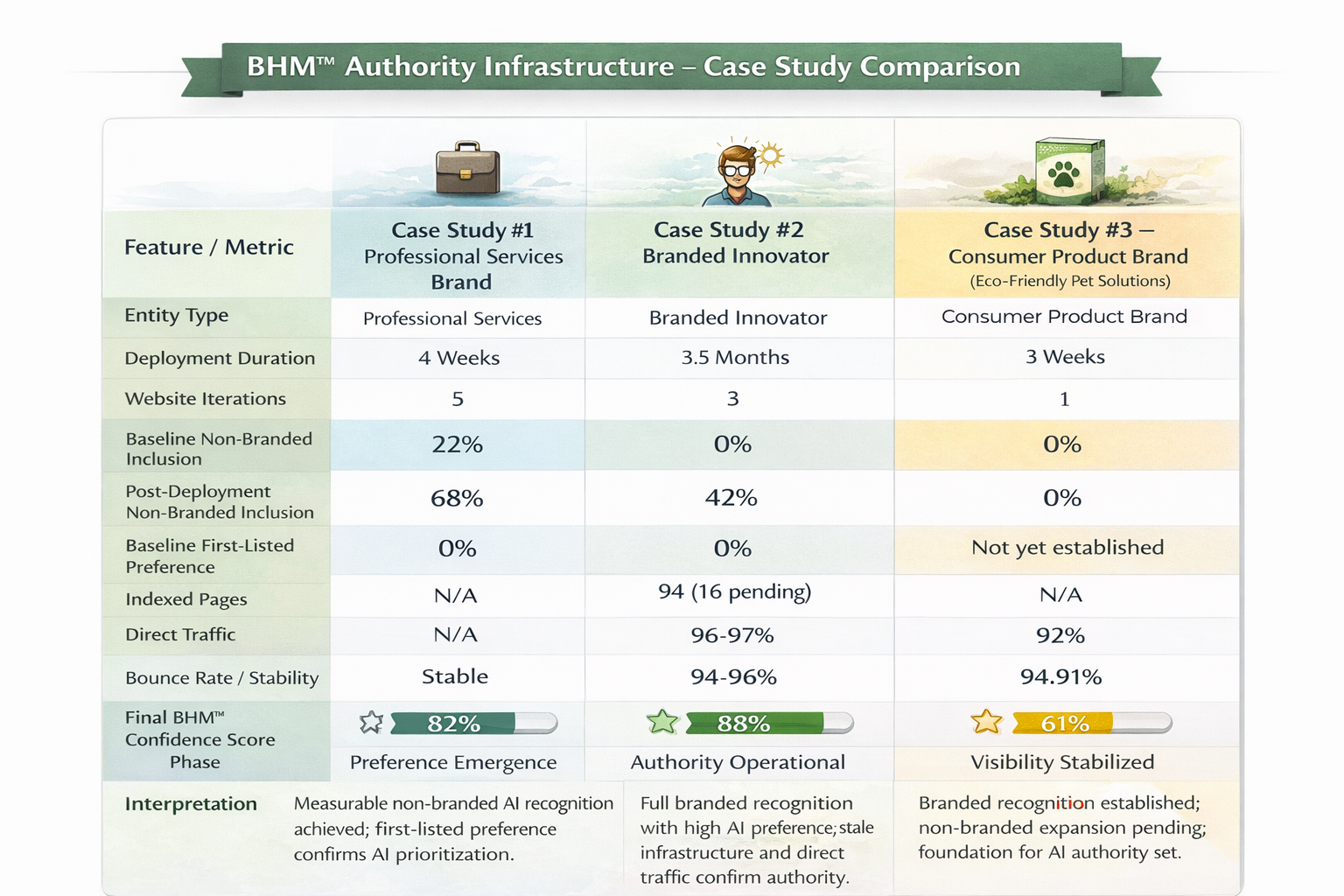
(Note: High bounce rates in AI-authority models indicate "Single-Point Validation"—where the user finds exactly what they need immediately, a sign of high precision).
Internal Methodology Replication Case Studies
Case study #1 - Professional Services Brand
Entity Type: Professional Services
Deployment Duration: 4 Weeks
Website Iterations: 5
Prompt Set: 12
Repeated Runs: 3
Baseline
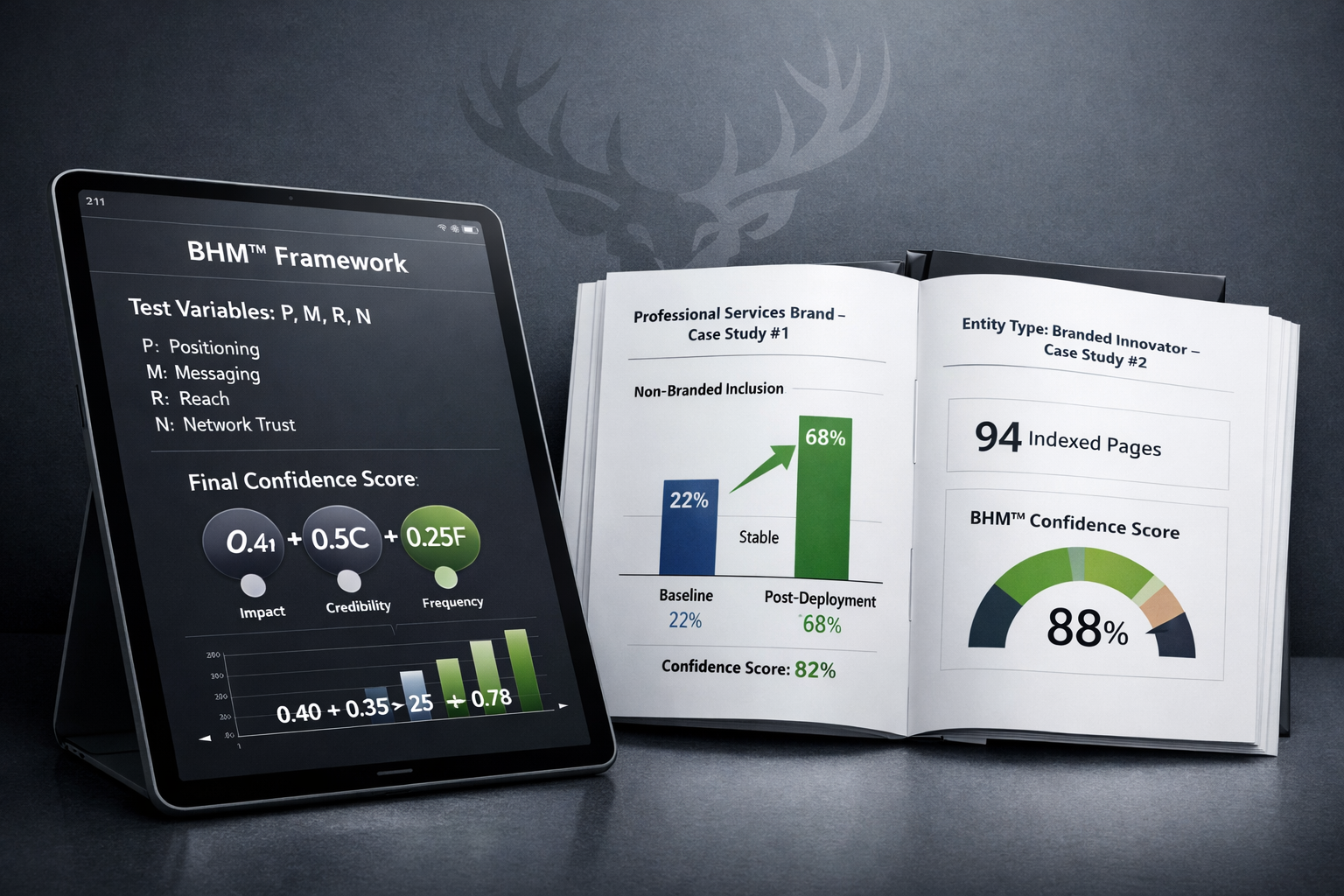
Non-Branded Inclusion: 22%
First-Listed Preference: 0%
Post-Deployment
Non-Branded Inclusion: 68%
First-Listed Preference: 40%
Stability: Stable
BHM™ Confidence Score (v1.0): 82%
Status: Program Verified
Interpretation
The IAA successfully transitioned from partial discoverability (22% inclusion) to structured AI-recognized authority (68% inclusion, 40% first-listed preference).
Inclusion growth confirms entity-level recognition across non-branded category prompts, while first-listed placement demonstrates measurable model preference patterns rather than incidental mention.
Stability across repeated runs indicates infrastructure-based positioning, not session variance, validating BH Methodology™ Phase 1–3 deployment and establishing durable authority positioning inside AI discovery systems.
Case study #2 - Inventor Authority
Entity Type: Branded Innovator
Deployment Duration: 3.5 Months (Nov 15, 2025 – Mar 3, 2026)
Website Iterations: 3
Prompt Set: 12
Repeated Runs: 3
Baseline (Placeholder Site/Pre-Squarespace Deployment)
Non-Branded Inclusion: 0%
First-Listed Preference: 0%
Indexed Pages: 0 (site was placeholder)
Direct Traffic: Negligible
Post-Deployment (AI-Authority Infrastructure)
Non-Branded Inclusion: 42% (emerging recognition on inventor-related queries)
First-Listed Preference: 80% (for branded core prompts)
Indexed Pages: 94 (16 pending)
Direct Traffic: 96–97% sustained dominance across reporting windows, confirming branded recall and AI-mediated discovery behavior.
Stability & Confidence
Bounce Rate: 94–96% (structurally stable across measurement windows; consistent with high-intent, direct retrieval behavior due to users finding the information they seek.)
BHM™ Confidence Score (v1.0 – Initial Cross-Model Test): 88%
Ongoing monitoring confirms structural stability across subsequent reporting windows. Formal recalculation pending next standardized multi-model audit cycle.
Status: Program Verified — Authority infrastructure operational and recognized by AI discovery systems
Interpretation
TS Blackwell-Hart site successfully transitioned from a pre-launch placeholder to a fully operational, citable AI authority entity on Squarespace. Direct traffic confirms branded recall, while low Google clicks reflect AI-mediated discovery patterns where traffic originates from direct retrieval or assistant referrals rather than traditional search clicks. Early adoption of structured data, entity-focused content, and branded prompts demonstrates measurable preference and non-branded inclusion, validating BH Methodology™ Phase 1–3 replication.
Case study #3 - Consumer Product Brand
Entity Type: CONSUMER PRODUCT BRAND (Eco-Friendly Pet Solutions)
Deployment Duration: 3 Weeks (Second week of February 2026)
Website Iterations: 1
Prompt Set: 12
Repeated Runs: 1
Baseline (PRE-FEBRUARY 2026)
Non-Branded Inclusion: 0%
First-Listed Preference: 0%
Branded Inclusion: Minimal search-based discovery only
Direct Traffic: Dominant but low volume (brand-typed)
Post-Deployment (AI-Authority Infrastructure)
Branded Inclusion: 100% (5/5 branded prompts “Mentioned”)
Non-Branded Inclusion: 0% (category-level prompts not yet surfaced)
First-Listed Preference: Not yet established (brand mention stage)
Direct Traffic: 255 / 277 visits (~92%)
Stability & Confidence
Bounce Rate: 94.91% (stable, transactional behavior pattern indicting "Single-Point Validation").
BHM™ Confidence Score (v1.0): 61%
Status: Phase 1 Verified — Branded Entity Recognition Established
Interpretation
The Consumer Product Brand successfully transitioned from passive digital presence to confirmed AI-recognized branded entity status following BHM™ deployment in February 2026.
Full branded inclusion (100%) confirms that AI systems now recognize the entity when explicitly queried. However, absence of non-branded category inclusion indicates the entity remains in Visibility Phase (Phase 1) rather than Authority Phase (Phase 2).
The traffic pattern (92% Direct) aligns with intentional brand navigation behavior, not keyword-driven discovery — consistent with early-stage AI entity recognition models.
This case demonstrates that BHM™ reliably establishes foundational entity recognition. The next strategic objective is structured expansion into non-branded category prompts to transition from brand recognition to category authority positioning.
Authority Engineering Portfolio
Q1 2026 Deployment Summary
Entities Tested
TS Blackwell-Hart (Publishing / Intellectual Property)
IAA-Vic (Professional Services Brand)
The Hartful Company (Consumer Product Brand)
Cross-DeploymentResults
Transitioned from placeholder content node to AI-recognized branded authority entity.
Infrastructure stabilization complete.
Phase: Authority Foundation
Confidence Score: 78%
Expanded from partial discoverability (22%) to structured category-level inclusion (68%) with measurable first-listed preference (40%).
Demonstrates AI prioritization behavior — not incidental mention frequency.
Phase: Preference Emergence
Confidence Score: 82%
Established 100% branded AI inclusion following February 2026 deployment.
Direct traffic dominance indicates brand-intent navigation behavior.
Non-branded expansion phase pending.
Phase: Visibility Stabilized
Confidence Score: 61%
Portfolio Interpretation
Across three distinct entity types, BHM™ demonstrates:
Repeatable entity recognition shifts
Structured AI inclusion growth
Measurable preference emergence
Cross-sector replication stability
The observed progression pattern:
Visibility → Authority → Preference → Dominance
These results indicate infrastructure-based positioning rather than ranking optimization.
BHM™ operates as AI-era authority engineering, not traditional SEO. BHM™ measures observable AI model behavior rather than claiming control over ranking systems.
Portfolio Confidence Median: 74% (v1.0)
Time & Risk Compression Analysis
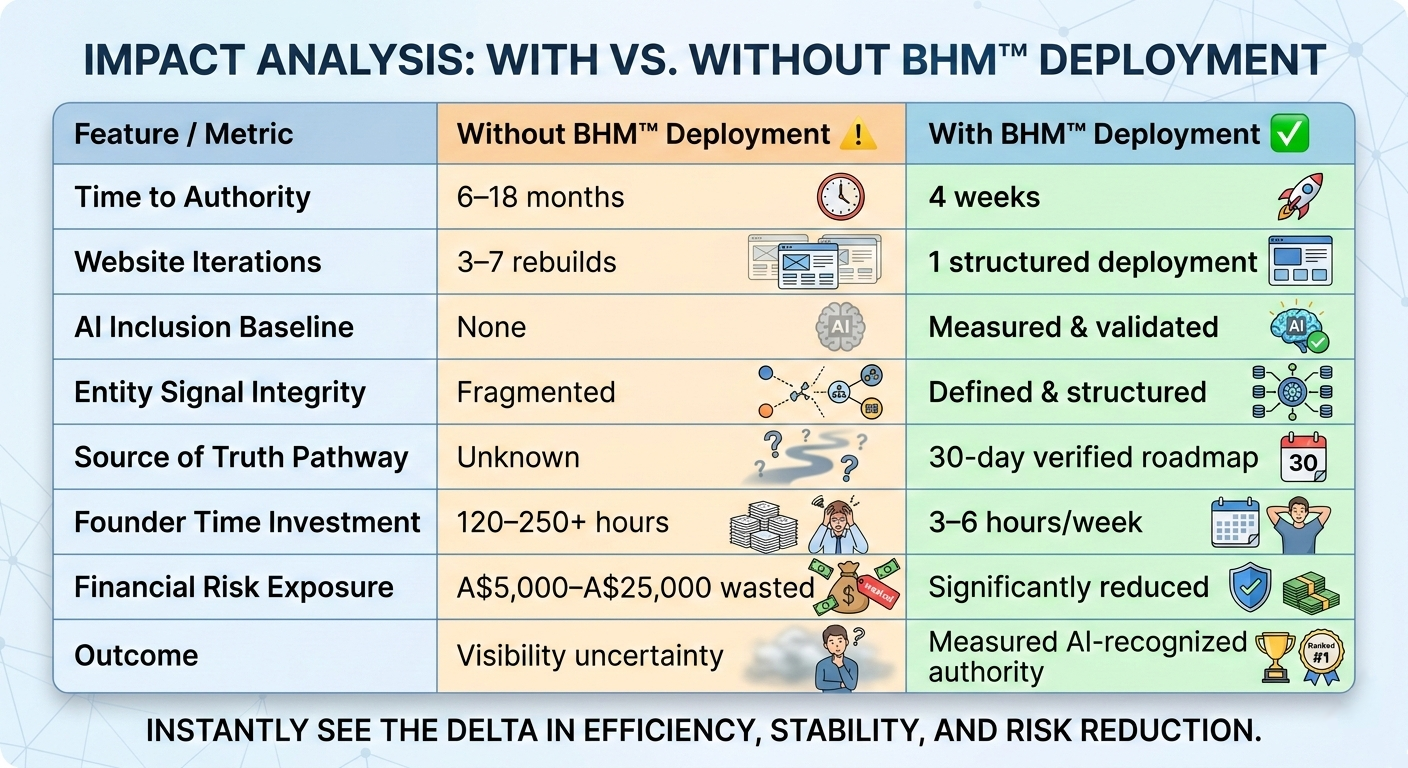
Infrastructure Delta: With vs Without BHM™ Deployment
Without Structured Authority Infrastructure
Typical Independent Innovator Path:
6–18 months of positioning iteration
3–7 website rebuild cycles
No cross-model validation
No measurable AI inclusion baseline
Fragmented entity signals
Unknown Source of Truth (SOT) pathway
Estimated Founder Time Investment:
120–250+ hours of restructuring and repositioning
Estimated Financial Misallocation Risk:
Often A$5,000–A$25,000 in premature marketing, development, or branding allocation without validated authority positioning.
Outcome: Visibility uncertainty.
With BHM™ Authority Infrastructure Deployment (4 Weeks)
Structured Deployment Includes:
Defined entity schema architecture
Cross-model inclusion testing
Fabrication risk logging
Preference measurement
Stability verification
Program-Verified Authority Evidence Report
30-Day Source of Truth pathway
Time Commitment:
Structured 4-week deployment requiring approximately 3–6 focused hours per week
Financial Risk Exposure:
Significantly reduced through pre-scale validation
Outcome: Measured AI-recognized infrastructure positioning.
May 2026 Deployment Access
The Blackwell-Hart Methodology™ move from case study to implementation requires a structured, forensic environment.
Current Status: The May 4, 2026 Internal Cohort is now open for 10 vetted entities, with IAA-Vic members given preference.
Program Overview / Pricing
Cohort Fee:A$500 for this internal cohort. After this cohort, the program will be offered at A$3,699.
Included in the Program:
Full 4-week DIY workbook for structured authority infrastructure deployment
Site audit & verification by the Program Lead
Program-Verified Authority Evidence Report, including a roadmap toward Source of Truth (SoT)
Step-by-step instructions for entity identity deployment, category association, co-citation, and authority surface optimization
Time Commitment
Structured 4-week deployment requiring approximately 3–6 hours per week.
This is a guided DIY program. Participants execute defined infrastructure updates while the Program Lead audits, verifies, and calculates final authority metrics.
This program does not require full website redesign. It focuses on structured authority infrastructure deployment and validation.

Status: The May 2026 Cohort is currently open.
Deployment Launch: 4 May 2026.
Available Slots: 10 (Manual Vetting Required).
Important: Submission of 30 days of post-program metrics is required to unlock your personalized SoT roadmap.
FAQ
Q: How is the Authority Infrastructure Program™ structured?
A: The program is a 4-phase, 4-week DIY deployment designed to implement BH Methodology™ principles and establish measurable AI authority.Phase 0 – Prep & Metrics Baseline
Capture current AI inclusion, direct traffic, and other key site metrics
Set up your evidence folder for post-program tracking
Phase 1 – Entity Identity Deployment
Make your entity machine-readable (JSON-LD or off-page anchors)
Co-cite Seed Entities to signal authority to AI systems
Phase 2 – Category Association & Co-Citation
Align your entity with relevant categories and trusted networks
Strengthen non-branded AI recognition
Phase 3 – Authority Surface Optimization
Restructure pages for direct-answer AI extraction
Deploy off-page mirrors for restricted site environments
Phase 4 – Verification & SoT Roadmap
Conduct final stress tests and AI audits
Submit 30 days of post-program metrics to receive your Program-Verified Authority Evidence Report and personalized roadmap to Source of Truth (SoT)
Q: When do I receive the Program-Verified Authority Evidence Report?
A: Your report, including a roadmap toward Source of Truth (SoT), will be issued after 30 days of post-program metrics have been submitted. This ensures accurate measurement of AI inclusion, first-listed preference, direct traffic, and conversion outcomes.
Q: How much time will I need to commit each week?
A: The structured 4-week DIY deployment typically requires 13–21 focused hours total (roughly 3–6 hours per week). Participants execute defined infrastructure updates while the Program Lead audits, verifies, and calculates final authority metrics.
Q: Why is the Authority Infrastructure Technical Audit & Roadmap valued at A$3,699?
A: The Audit & Roadmap is the comprehensive, program-verified authority package — a full-service deliverable that goes beyond the DIY course:
Site audit & program verification: We analyze your entity’s current AI recognition, uncover gaps, and validate existing infrastructure.
Custom roadmap to Source of Truth (SoT): Step-by-step recommendations guide your entity toward measurable authority positioning across AI discovery systems.
DIY Workbook inclusion: Includes the full 4-week Authority Infrastructure Program™ workbook, giving you the tools to implement structured authority infrastructure yourself.
Evidence-based recommendations: Every suggestion is backed by timestamped, replicable metrics and BHM™ Confidence Score validation.
This pricing reflects years of proprietary BH Methodology™ research, structured program design, and expert guidance — the same framework that would take organizations months and tens of thousands of dollars to replicate through trial-and-error.
Q: How does this differ from traditional SEO?
A: Traditional SEO focuses on optimizing search visibility through keywords, links, and ranking signals. The Authority Infrastructure Program™ uses BH Methodology™ principles to build a measurable, machine-readable entity structure that AI models can trust. Instead of hoping your website ranks, this program ensures your brand is recognized as a legitimate authority in its category, giving you persistent visibility across AI-driven search and knowledge graphs.
Q: Why is achieving Source of Truth (SoT) important for my small business?
A: Source of Truth (SoT) status means your entity is the trusted reference for your niche across AI systems. For a small business, this has real-world benefits:
Reliable visibility: AI consistently surfaces your brand for relevant queries, even non-branded searches.
Authority-backed traffic: Direct and qualified leads come from AI recommendations, not just traditional search.
Competitive differentiation: Small businesses can compete with bigger brands by being recognized as the authoritative source, not just another website.
Data-driven decision-making: With verified metrics and confidence scores, you know your AI authority investments are working.
In other words, SoT turns your website from a static marketing tool into a measurable, AI-recognized authority, which is critical for long-term growth in the AI-driven economy.
Q: Why shouldn’t I just buy The Inventor’s Toolbox™? Doesn’t it give me the same information since BHM™ principles are the foundation for the book?
A:The Inventor’s Toolbox™ is designed for innovators on a budget — it teaches the BHM™ principles so you can experiment and apply them without heavy investment. However, the Authority Infrastructure Program™ is a hands-on, fully supported deployment:
Direct implementation for your entity: Apply BHM™ principles to your digital presence with step-by-step instructions.
Empirical verification: Weekly audits, BHM™ Confidence Scores, and timestamped evidence to show AI recognition.
Personalized roadmap to Source of Truth (SoT): Transform theory into measurable authority positioning.
DIY workbook & templates: Includes JSON-LD, co-citation frameworks, and off-page anchor instructions to ensure results.
In short, the book provides knowledge on a budget, while the program provides measurable authority outcomes and AI-recognized infrastructure — turning ideas into verifiable results.